Book Club Traveler is now Off the Beaten Page Travel

It’s been quite a while since my last post because I’ve been hard at work on a forthcoming book entitled Off the Beaten Page: The Best Trips for Lit Lovers, Book Groups and Girls on Getaways, which will be out in May.  The book explores the idea of literary travel– what it is, how to plan lit trips large and small, and 15 of the best places in the U.S. for where you can both explore the settings of great books and have a great time with friends. I’m starting the new year with a new blog, Off The Beaten Page Travel, which will work in conjunction with the book, serve as a place to update lit lovers on my literary travel adventures as well as a forum where readers can share their ideas, too.

I have moved the content from Book Club Traveler to this new blog, so if you’re a subscriber to BCT, please subscribe to Off the Beaten Page Travel (www.offthebeatenpagetravel.wordpress.com).  You’ll find both the information from the last couple of years along with new and frequently updated thoughts on reading and travel. The goal will remain the same as my tagline says, “Travel to the places you’ve read about. Read about the places you travel.”

Preserving F. Scott Fitzgerald's Birthplace

My book club took a little F. Scott Fitzgerald tour in St. Paul a few weeks ago.  We walked around the neighborhood where he was born and grew up, taking in his various residents and hang-outs and staring as so many Fitzgerald pilgrims do at the house where he was born at 481 Laurel Avenue.  (See my previous post on the St. Paul Fitzgerald tour. We gathered just off the front porch and gazed up like a bunch of tourists and in a few minutes one of the people who live in the building, Richard McDermott, saw us and called us in for a little talk about the building, which was a real treat because he was instrumental in preserving the building. I was sad to see in the Minneapolis Star Tribune an article about him and the fact that he has terminal cancer.  He has done much to preserve Fitzgerald’s heritage in St. Paul and had regaled visitors from around the world, including Azar Nafisi, with stories about the building. Here’s an article about the charming Mr. McDermott

Literary Death Match: A Cerebral Slugfest

I’m heading over to the Literary Death Match (LDM) tonight, which sounds like some sort of mixed martial arts combat. But, there will be no Junior dos Santos, Antonio “Bigfoot” Silva or other UFC luminaries at tonight’s competition at the Nomad World Pub in Minneapolis. (I’m hoping to see some beefcake, but keeping my expectations low.) Despite its violent-sounding name, LDM is a comedic/literary competition that has made its way around the globe and regularly stops in the Twin Cities. These are great events for book clubs to attend together. Four authors read something they’ve written and three literarily (is that a word?)-inclined judges offer their comments on each reading, with an emphasis on humor rather than violence, though there is sometimes beer-fueled mayhem as the audience votes on the winner. Everyone goes home happy—no bruises, even to their egos.

Tonight’s readers include L.A. Times-award-winning young-adult novelist Pete Hautman (The Big Crunch and The Obsidian Blade), Minnesota Public Radio Electric Arc Radio‘s Stephanie Wilbur Ash, poet and author Juliet Patterson (author of Truant Lover) and poet-musician Jeffrey Skemp (author of Spent). The judges: Jamaican native Marlon James (author of The Book Of Night Women and John Crow’s Devil), cartoonist and host of the Lutefisk Sushi podcast Danno Klonowski, and former journalist turned sci-fiction writer Dennis Cass.

LDM creator and host Todd Zuniga works as hard as any fight promoter to put these shows together and hopes eventually to bring LDM to television.  He says, “Literary Death Match started because there was a real need to evolve literary events beyond a bar reading where Reader 1 would read for 12 minutes beyond the time limit, Reader 2 would read a slice-of-life blog entry they wrote earlier that day and Reader 3 would blow everyone’s mind. We wanted an event where everyone was Reader 3. So, we went around and asked literary entities and asked them to send us someone to represent them. Secondly, we wanted to seamlessly integrate comedy into a literary night, and that’s where the judges come in — regardless if the story was about a bad day at work, or surviving cancer.”

Todd shares my passion for making reading a way to create community and sees a trend toward people seeking entertainment and social connection through activities that exercise a bit of brainpower like LDM, a cerebral form of extreme cage fighting. He says, “LDM is a highly intellectual event, but we’re also zany and love bolts of silliness. I’m my mother’s son, so I want everyone in the room to feel good after it’s done. And what’s better than having a real conversation with someone fantastic? Our goal is to get people to read, and to keep helping people to understand that books aren’t always a solitary, lonely affair. We want to fill the room with the smartest, kindest, most fascinating people we can find. So, after the event they can talk about Etgar Keret’s Suddenly a Knock at the Door before they talk about the latest episode of Mad Men or Breaking Bad.”

Um, I have to figure out who Etgar Keret is before I can join that conversation, but I am looking forward to watching a few rounds of literary pugilism. Kudos to The Loft Literary Center for sponsoring this event.

Stanley and Stella Shouting Contest in New Orleans

Stella!

I just got back from a few days in New Orleans where I caught a portion of the Tennessee Williams/New Orleans Literary Festival.  The fest features famous writers, actors and authors (this year including Piper Laurie, Amanda Plummer, and playwright John Guare)  performing and discussing their work and that of Tennessee Williams.  Touring around the city, I was amazed to see New Orleans’s huge comeback after Katrina.  I thought I would see areas that still looked demolished, but with a few exceptions the city is back in shape and New Orleans tourism has hit the level it was before 9/11.  Beyond that, the city is as crazy as ever, with an above-average level of drinking.  As an example of “only in New Orleans” behavior, I offer the Stanley and Stella Shouting Contest, which caps off the Tennessee Williams Festival.  Click on the following link and watch the video that appears at the end of the page.  It’s just great. www.nola.com/news/index.ssf/2012/03/photos_and_video_stella_and_st.html

Beyond Austin into the Texas Hill Country

A Texas Longhorn Grazing in the Hill Country

Though the South by Southwest music, film and interactive fest has dominated Austin lately, the city has has a ton to offer year-round including great food, shopping, and music coming out of every doorway on 6th Street. In addition, if you have an extra day on your visit to Austin, you’ll find plenty to see, do and eat in the Hill Country west of Austin. It offers a chance to see the Texas countryside, with stunning wildflowers in spring, and even a few longhorn cattle.

Head first to Fredericksburg, a charming town that German settlers founded back in the mid-1800s. A trip down Main Street there is like a walk back into the old west, lined with historic limestone buildings, but with cute shops that cater to tourists on the inside. If it’s hot, you’ll find plenty of beer gardens and craft beer to slake your thirst.

The Texas White House of LBJ

Turn back in the direction of Austin, and pay a visit at the Lyndon Baines Johnson Ranch, home of our 36thPresident, and known as the Texas White House during his presidency.   Be sure to read Doris Kearns Goodwin’s Lyndon Johnson and the American Dream or Billy Lee Brammer’s, The Gay Place which is about Texas politics and Lyndon Johnson to get the most out of your visit here. The ranch is now operated by the National Park Service. You can tour both an historic Texas farm and the Texas White House, circa 1968. It’s a great way to get off the road and see what a Texas ranch looks like, get a look at the lovely Pedernales River, and see the ranch house as it was, right down to the clothes in the closets.

End your day with a stop in Driftwood at the legendary rib joint and meat-lovers heaven, the Salt Lick. (Cash only and B.Y.O.B. or purchase a beer and wine a the wine bar next door.)

Vivid: South Beach Lifeguard Houses, Miami Beach, Florida

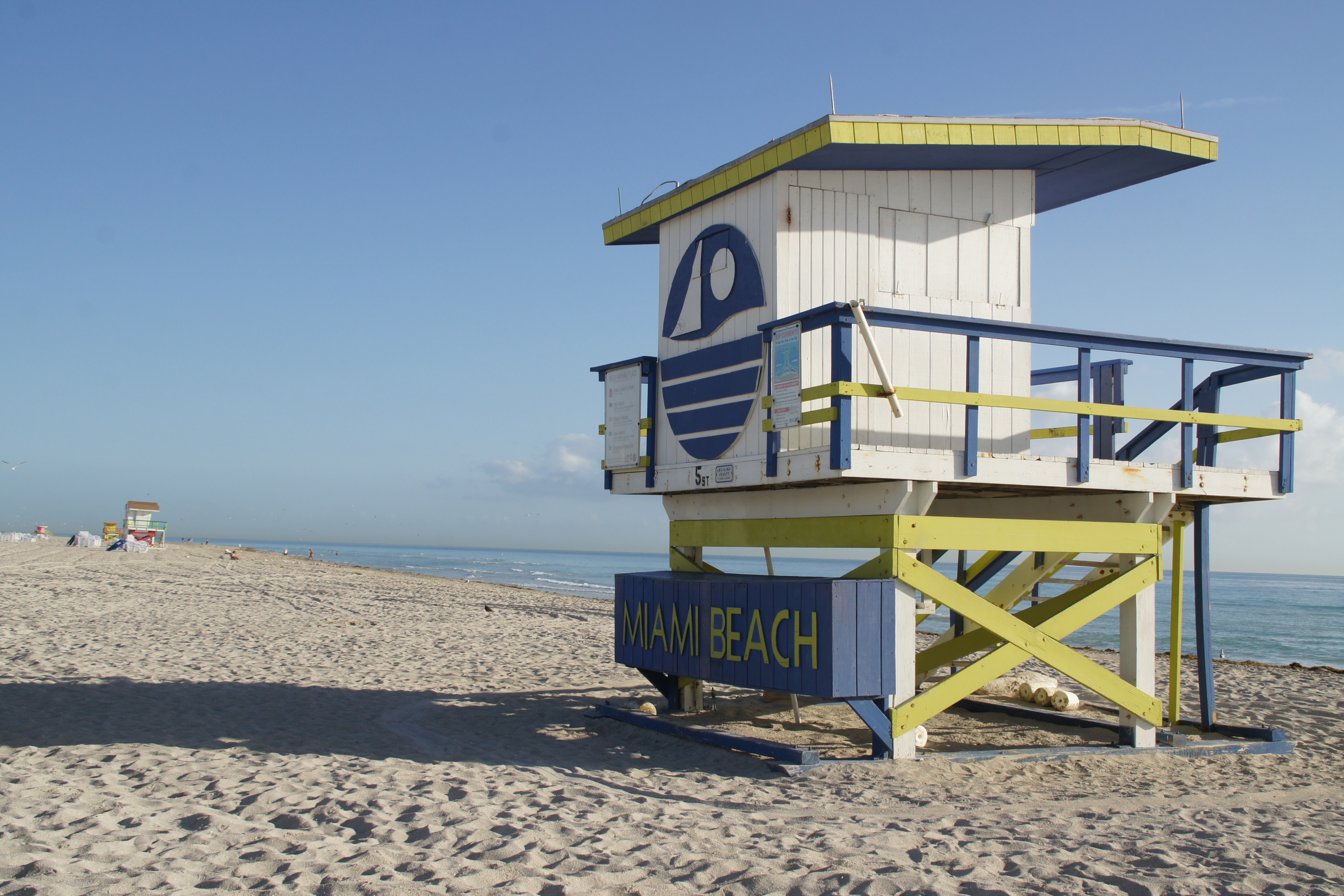
The 5th Street Guardhouse– beach yoga and a cruise ship leaving port.

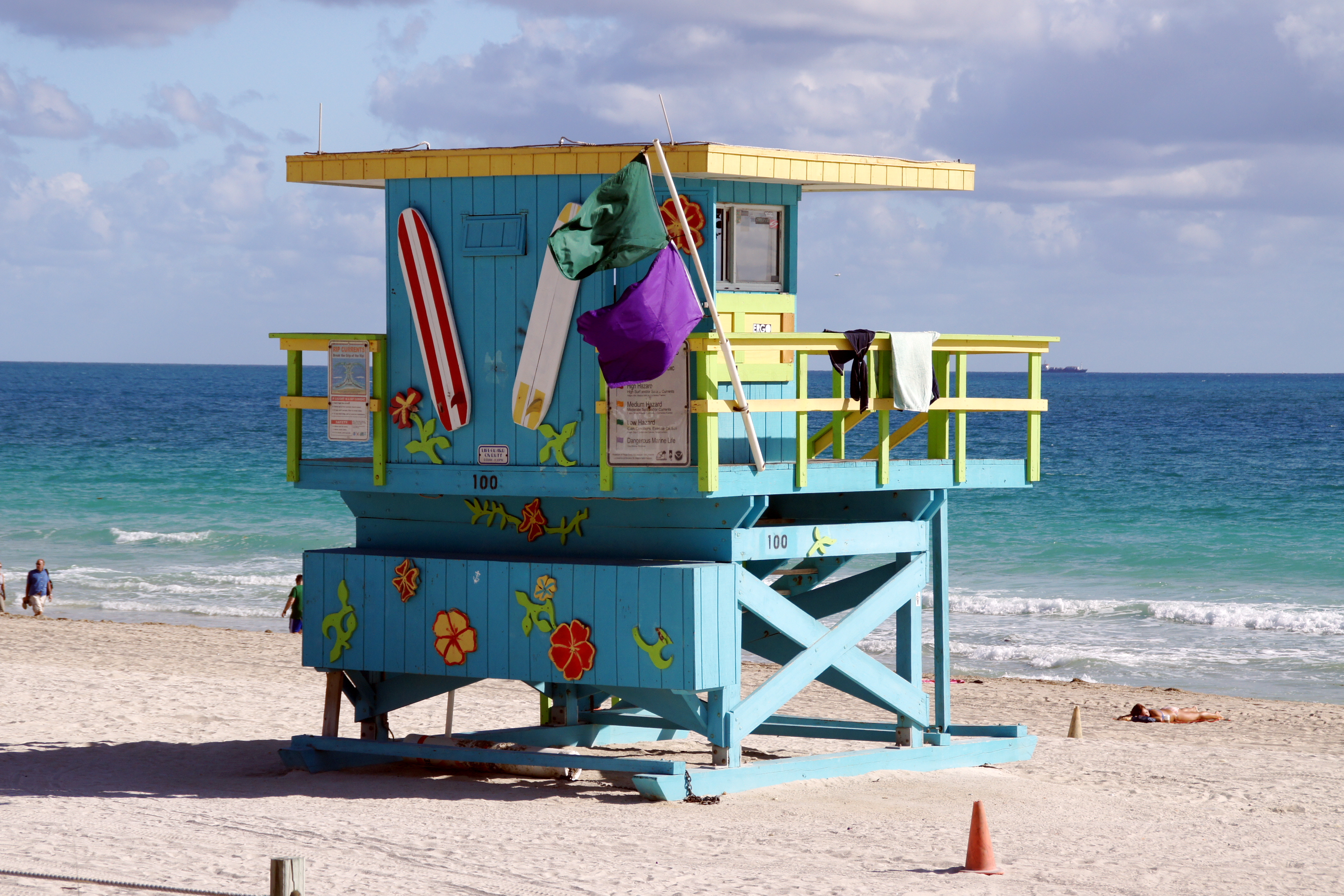
The hotels and other buildings in the South Beach art deco district of Miami Beach, Florida, get all the attention.  But if you’re there, you should lift your head up from your beach chair and take notice of the collection of whimsical and funky lifeguard stations that extends from the jetty at South Point to 74th Street.  If you can’t make it to South Beach, take a look at photographer and former newspaper journalist Susan Russell’s book, aptly titled South Beach Life Guard Stations to see what I’m talking about.

While there have been elevated lifeguard stations here almost since the area became a resort, they weren’t so interesting until Hurricane Andrew swept most of them away in 1992.  They were rebuilt with panache typical of South Beach. They serve a very practical purpose for lifeguards, but also make great landmarks when you stroll the beach and an excellent place to meet for beach yoga at sunrise.  Here are a few of more….

The Towers Guardhouse, a.k.a. The Surfboard, South Beach, Florida
Lifeguard station at the jetty, where you can see the entire vista of South Beach
The 5th Street Guardhouse, with a version of the Miami Beach logo.

Shadow Country and Swamplandia! in Florida's Ten Thousand Islands

Grinning gators galore in the Everglades.

If you’re a fan of Peter Matthiessen’s National Book Award winner, Shadow Country, you

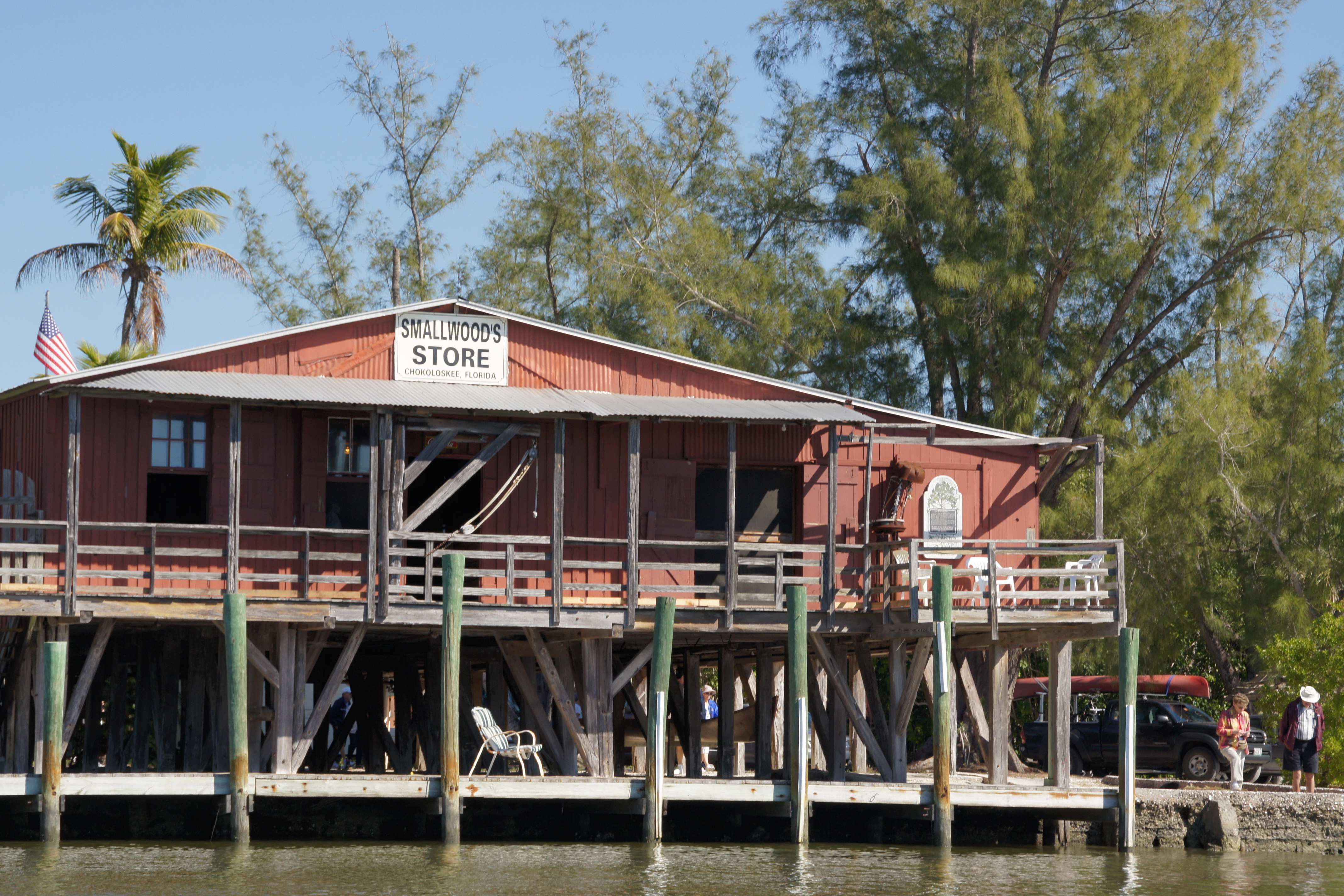
Smallwood Store, scene of E.J. Watson's murder.

may already have taken a day out of a Florida vacation and traveled to the Ten Thousand Islands area of southwest Florida to get a look at where the story happened.  Shadow Country is a fictionalized account of the story of the notorious real-life Everglades sugar cane planter and outlaw E. J. Watson at the turn of the 20th century.  But now, Karen Russell’s Swamplandia! (the fictional story of Ava Bigtree, a 12-year-old alligator wrestler who embarks on a strange journey through the area’s mangrove wilderness in search of her lost sister) creates another reason to investigate this section of the Everglades. So, last week a friend and I made the two-hour trip from Miami (it’s much closer to Naples on Florida’s Gulf Coast) to get a view of the mysterious watery world of these books.

We set out with fishing guide, Captain Rodney Raffield, from his home on Chokoloskee Island. Unlike the northern saw grass portions of the Everglades where the water is fresher, this section consists mostly of thousands mangrove islands in saltwater near the Gulf of Mexico. The Watson place is now a remote National Park Service campsite.  There isn’t

What's left of the Watson Place.

much left of the homestead except a huge vat where they boiled sugar cane to make syrup.  However, the Smallwood Store, the site where E.J. Watson was murdered by his neighbors, is still there on Chokoloskee Island and open as a

museum.

A boat ride around the area offers an impressive glimpse of the seemingly unending expanse of the Everglades.  To a visitor, there seem to be very few landmarks, so it was a pleasure to travel with Raffield, an affable fifth-generation resident of the area and a former stone crab fisherman who knows the place like the back of his hand and has plenty of stories to prove it.  As we wound our way through the mangrove islands, which are really just clumps of tangled roots rather than solid ground, we saw huge numbers of nesting birds. And, the alligators lolling on every open bank (some as much as twelve feet long), were the kind one might see on a tour of Russell’s fictional alligator park Swamplandia! Neither sea nor land, the Ten Thousand Islands make the perfect setting for Ava’s ghostly and gothic travels through the backwaters.

White pelicans near Rabbit Pass Key, Ten Thousand Islands, Florida

It’s a place where anything could happen… even something as unlikely as we non-fishers casting our lines for a few minutes and catching a “mess a fish,” as Raffield says. We then hustled over to the Havana Café in Chokoloskee, where they cooked ‘em up and we ate ’em, back on solid ground.

Walking the High Line, NYC

A couple of weeks ago, I walked the High Line in New York City for the first time since

Billboard art by John Baldessari on the High Line in New York City.

the new section was added.  The High Line is an elevated park that was originally an elevated railroad line, built in the 1930s.  It lifted freight traffic 30 feet above the ground removing dangerous trains from the streets of Manhattan’s  largest industrial district. It went out of use in 1980, but when it was under the threat of demolition, Friends of the High Line worked to preserve it as an elevated park.  So, think railroad bed turned garden. The first section, from Gansevoort Street to West 20th Street, opened June 9, 2009. The second section, from West 20th Street to West 30th Street, opened last spring.

I thought it might be dull to walk the High Line in winter, but there’s plenty to enjoy, with winter plantings, art installations, and impressive views of the New York skyline, especially the Empire State Building and the Hudson River.  This time, we got on at 14th Street and walked north to 30th Street.  Along the way there are great restaurants and bars.  We  then wandered through a few of the art galleries that now populate the Chelsea neighborhood in droves. Gallery openings take place on the first Thursday of the month.  To get a glimpse of the New York art scene, read Steve Martin’s Object of Beauty.  It’s not my favorite book, but he knows and describes the New York art scene well. We capped off our walk with lunch at the Chelsea Market.

On an entirely different subject, I had to add a photo of a dog I saw at the holiday market at Union Square, who didn’t seem to be too humiliated to be wearing this outfit.

Murder and Mayhem: Investigating Crime Fiction

I hardly ever read crime novels. When I have, the experience has usually been a disappointment. The books were “low-brow,” with weak characters, predictable plots and lame dialog. However, this genre is so popular I’ve always figured that I must somehow be missing the good stuff. It was a mystery to me.
Another fact that has piqued my curiosity about crime novels is that the Twin Cities area, where I live, has more crime writers per capita than just about anywhere. A few years ago, an article in The Economist of all places, speculated, “Why do the Twin Cities create so much literary gore?” The answer was three-fold. There are a lot of advertising agencies here, which have spun out several successful crime writers (not sure about that connection aside from a very abbreviated, direct writing style). Also, several former reporters for the two major newspapers here have moved from journalism to fiction, true crime to the imaginary version. Finally, some attribute it to the weather. One writer, Brian Freeman, who has published a crime novel set in Duluth, in northern Minnesota, explained to The Economist, “What is there to do during those long winter months beside sit inside and think dark thoughts of murder and mayhem?”

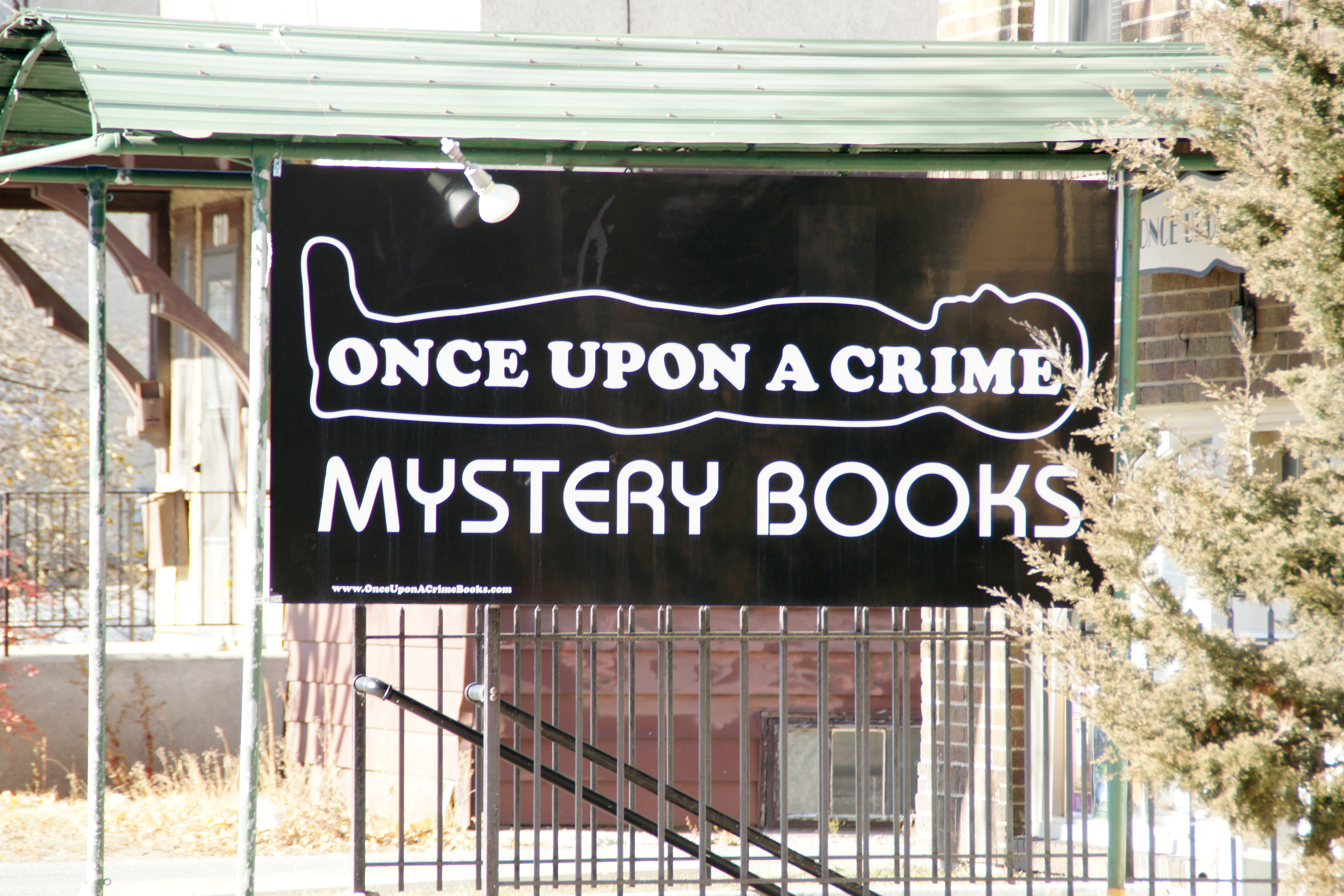
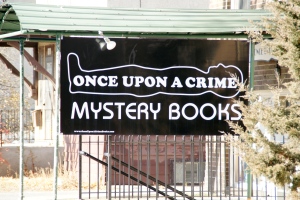
I decided to conduct my own investigation into the virtues of crime fiction and go to the source, Once Upon a Crime, the bookstore in Minneapolis. Tucked into the lower level of a building on 26th Street, just east of Lyndale Avenue, Once Upon a Crime is truly a hidden gem, though not a secret to crime fiction lovers.  Pat Frovarp owns the shop with her husband, Gary, and a dog appropriately named Shamus,  She doesn’t just know about the writers, she knows a huge number of the writers personally. This year the store won The Raven Award, the top honor for non-authors given at the annual Edgar Awards, sponsored by the Mystery Writers of America.

She gave me a quick tutorial on the genre and revealed a world far more intriguing than those crime or thriller books one sees on the racks in grocery stores and airports. The store handles fiction only, no true crime. Under this umbrella one can find countless sub-genres, something for every taste—“hard-boiled” and violent to “soft-boiled” Agatha Christie-type works which Pat calls “cozies.”  Pick just about any part of the world or any period in history, there’s crime fiction that takes place there. Best of all, for someone like me, there are works that weave in history and that I (yes, snobbishly) would call “literary.”  I had trouble narrowing it down, but I left the store with The Canterbury Papers, a novel by Minneapolis writer Judith Koll Healey that takes place in the Middle Ages and Big Wheat, a mystery story set in the Dakotas in 1919, by St. Paul author Richard A. Thompson.

I can’t wait to settle in for a long read on a dark and stormy (and cold) night.  I also anticipate going back to visit Pat for a discussion of books, crime and dogs.

Travel to the places you read about. Read about the places you travel.