I’m working on a book about reading and travel and searching for book clubs around the country who have taken a book-related trip together. I’d love to hear from you. Send comments. Thanks.
Terri

I’m working on a book about reading and travel and searching for book clubs around the country who have taken a book-related trip together. I’d love to hear from you. Send comments. Thanks.
Terri

If you’re a fan of Peter Matthiessen’s National Book Award winner, Shadow Country, you
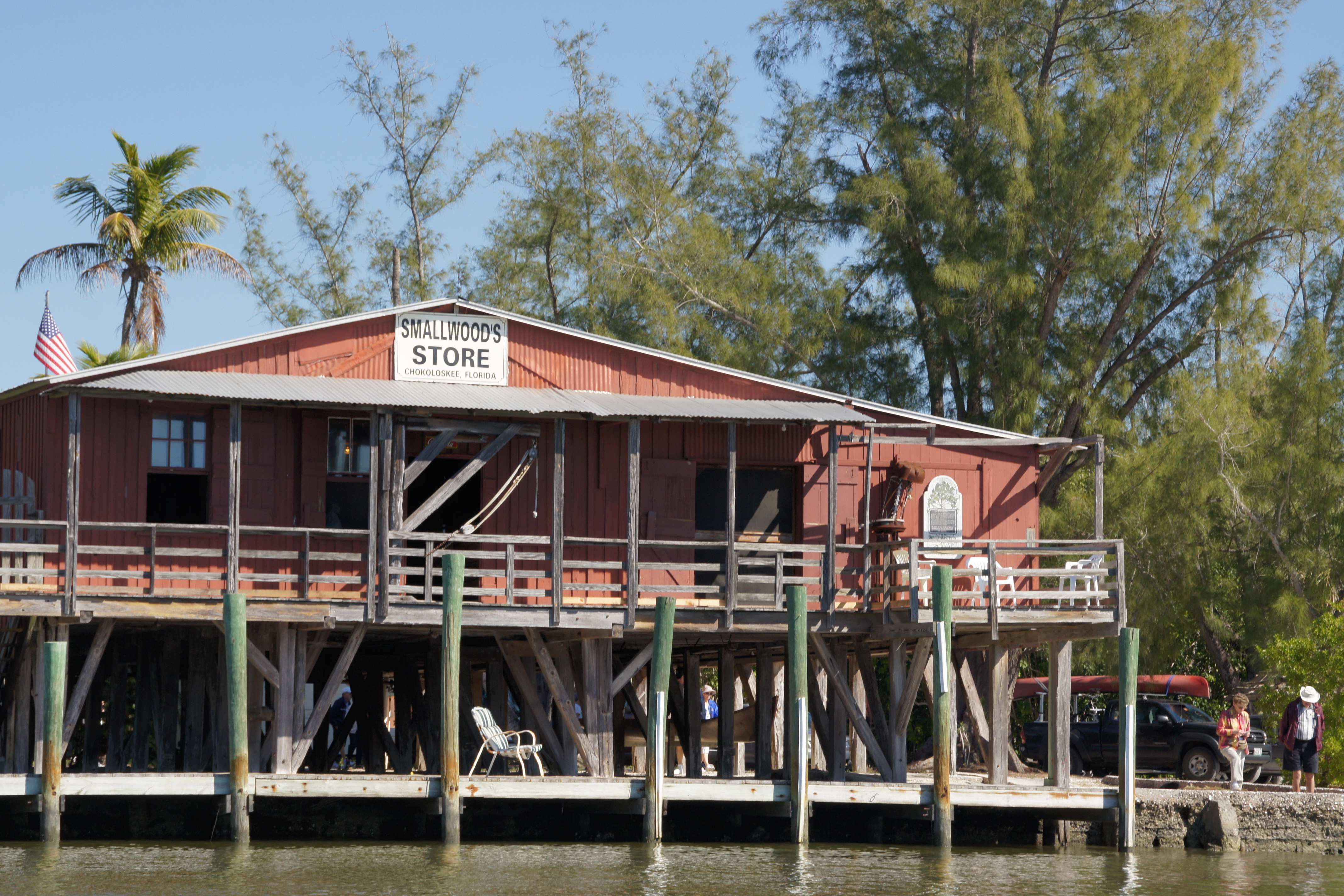
may already have taken a day out of a Florida vacation and traveled to the Ten Thousand Islands area of southwest Florida to get a look at where the story happened. Shadow Country is a fictionalized account of the story of the notorious real-life Everglades sugar cane planter and outlaw E. J. Watson at the turn of the 20th century. But now, Karen Russell’s Swamplandia! (the fictional story of Ava Bigtree, a 12-year-old alligator wrestler who embarks on a strange journey through the area’s mangrove wilderness in search of her lost sister) creates another reason to investigate this section of the Everglades. So, last week a friend and I made the two-hour trip from Miami (it’s much closer to Naples on Florida’s Gulf Coast) to get a view of the mysterious watery world of these books.
We set out with fishing guide, Captain Rodney Raffield, from his home on Chokoloskee Island. Unlike the northern saw grass portions of the Everglades where the water is fresher, this section consists mostly of thousands mangrove islands in saltwater near the Gulf of Mexico. The Watson place is now a remote National Park Service campsite. There isn’t

much left of the homestead except a huge vat where they  boiled sugar cane to make syrup. However, the Smallwood Store, the site where E.J. Watson was murdered by his neighbors, is still there on Chokoloskee Island and open as a
museum.
A boat ride around the area offers an impressive glimpse of the seemingly unending expanse of the Everglades. To a visitor, there seem to be very few landmarks, so it was a pleasure to travel with Raffield, an affable fifth-generation resident of the area and a former stone crab fisherman who knows the place like the back of his hand and has plenty of stories to prove it. As we wound our way through the mangrove islands, which are really just clumps of tangled roots rather than solid ground, we saw huge numbers of nesting birds. And, the alligators lolling on every open bank (some as much as twelve feet long), were the kind one might see on a tour of Russell’s fictional alligator park Swamplandia! Neither sea nor land, the Ten Thousand Islands make the perfect setting for Ava’s ghostly and gothic travels through the backwaters.

It’s a place where anything could happen… even something as unlikely as we non-fishers casting our lines for a few minutes and catching a “mess a fish,” as Raffield says. We then hustled over to the Havana Café in Chokoloskee, where they cooked ‘em up and we ate ’em, back on solid ground.
I’ve been reading a lot lately about how e-books are totally changing the world of reading, forcing bookstores out of business, panicking print publishers, and leaving authors confused about where to get their books published. A recent article in the Los Angeles Times urges readers to visit literary sites in New York City before they disappear. The article discusses bookstores in particular, which have been struggling for quite while, first with the rise of giant chains such as Barnes & Noble and Borders (which recently bit the dust itself), then with Amazon and Internet book sales, and now with electronic books. For example, there used to be forty-some bookstores on Book Row along Fourth Avenue in New York, a book-lover’s nirvana.
I wish I could have seen that, wandered the stacks, and talked with the owners who I imagine as eccentric, bespectacled, and just oozing knowledge about authors and what to read next. I would have been a loyal patron. The Strand bookstore is the lone survivor of Book Row, and had moved to 12th and Broadway. Take a look at their video. The Strand and most other bookstores seek to do things not available in the online world such as events with authors (live and in-person!), children’s activities, and other activities that make them unique. A post on literarymanhatten.org sites the example of “another independent bookstore making the most the downfall of corporate chains. Housing Works Bookstore Café. Part Bookstore, part café, part thrift shop and part HIV/AIDS outreach program. “Housing Works,” they say, “understands the value that creating a community can give to a bookstore.”
Birchbark Books in Minneapolis offers all sorts of community-building book/author/dinner events and the store has a special focus on Native American literature and concerns. They’re hosting screenings of “H2Oil,” an acclaimed documentary film about the devastating effects of the Alberta Tar Sands. Marty Cobenais from the Indigenous Environmental Network will speak about the campaign to stop tar sands pipelines in the United States. Bookstore owner Louise Erdrich will be giving an introduction. Another example, with a more light-hearted focus is Beauty and the Book in Jefferson, Texas, the world’s only combined beauty salon and bookstore. It’s owner, Kathy Patrick, has turned turned the love and books and book clubs into an international pursuit with the many chapters of her Pulpwood Queens Book club.
Whatever huge upheavals the book business encounters, one thing won’t change—the places (real and fictional) that literature evokes. For adventurous lit-lovers, there’s nothing like visiting the places they’ve seen in their imaginations—the London of Dickens’ characters for example, the Stockholm of Steig Larsson’s The Girl Who Kicked the Hornet’s Nest or the wide open Texas spaces of Larry McMurtry’s Lonesome Dove, to name just a few. And, I maintain there’s no better way to gain a sense of a place before you travel there than to read about it. I enjoyed seeing at good example of how reading amps up the anticipation of a trip, too, in a blog post about an upcoming trip to Spain on The Orange Barrow that features the blogger’s reading list.
So, next time I’m in New York I’ll walk by Tiffany’s with Holly Golightly, through Washington Square with Henry James or through Harlem with Langston Hughes, and rest assured that there are locales of classic literature won’t soon disappear.
I just finished reading A Skeptic’s Guide to Writers’ Houses, a tour of the homes of writers ranging from Hemingway to Poe to Langston Hughes by writer and English professor Anne Trubek. In this funny and very insightful book, Trubek examines the lure of writers’ homes for readers and for herself. And a big draw it is; she says there are about seventy-three writers houses open to the public in the U.S. and hundred of thousands of people visit them annually, 60,000 a year to Mark Twain’s house in Hartford alone. But, such pilgrimages aren’t always very satisfying. She says
Writers’ house museums expose the heartbreaking gap between writers and readers. Part of the pull of a writer’s house is the desire to get as close as possible to the precise, generative, “Aha!” But we can never get there….Going to a writer’s house is a fool’s errand. We will never find our favorite characters or admired techniques within these houses; we can’t join Huck on the raft or experience Faulkner’s stream of consciousness. We can only walk through empty rooms full of pitchers and paintings and stoves.”
But A Skeptic’s Guide is entertaining precisely because, for Trubek the houses always come up short, which she describes in a pleasantly un-snarky way. For example, visitors and tour guides often seem to confuse the idea that a house was where the writer lived and not where the fictional characters like Huck Finn or Jo in Little Women lived. The furniture, papers and other items in the houses are often not those that belonged to the writer, but are things the curator added willy-nilly. Edith Wharton’s home, The Mount, is decorated as a modern-day show house, computer and all. Most houses seem to have the same array of merchandise in the gift shop.
I agree with her. I’ve never really seen the lure of an author’s homes as some way to commune with the departed genius or magically attain the writer’s magic for my own use. However, I’m fascinated with the sense of place that literature creates. When I read about Huck Finn, it makes me want to not visit Twain’s Hannibal home but rather to hop in a boat and travel down the Mississippi. For a Yankee like me, it’s exciting to visit the Carolina lowcountry I’ve read about in books such as Pat Conroy’s Prince of Tides or The Water is Wide. I get a better understanding of the real people who live there as well as their history and the geography that has shaped it.
Ultimately, the essence of the writer isn’t in the house, it’s in the words. Trubeck concludes, “[Langston] Hughes knew that …the world of the imagination would offer him more than the city, more than a house.”
Famed historian David McCullough gave a presentation about his new book, The Greater

Journey: Americans in Paris, on Tuesday night in Wayzata, Minnesota, near Minneapolis. It’s the story of American artists, writers, physicians, politicians and others who traveled to Paris between 1830 and 1900 to further their education and to excel at their work. I highly recommend it to anyone traveling to Paris.
But one of the most interesting parts of the evening was when someone asked McCullough his opinion of Americans’ knowledge of history and the way history is taught in our schools. That’s a particularly hot topic this week because of Sarah Palin’s rewriting of history and also because the National Assessment of Educational Progress found that American students are less proficient in their nation’s history than in any other subject. The New York Times said that, according to results of a nationwide test released on Tuesday, most fourth graders were unable to say why Abraham Lincoln was an important figure. McCullough’s suggestion: don’t fault the teachers. It’s our own responsibility. Parents, grandparents, and others must do a better job of showing an interest in history and discussing it with children.

Family road trips are one of the best ways to do that. It’s what educators call “placed-based learning” and, it ties in nicely with the idea of inspiring children to read by making stories more vivid and bringing reading to life. I’m not talking about hard-core history books here, but rather books that are fun to read. For example, read Esther Forbes’ Johnny Tremain and visit Boston. Pair Mark Twain’s Huckleberry Finn or Tom Sawyer with a trip to see the Mississippi River or Twain’s home in Hannibal Missouri. Read the Little House on the Prairie series and travel to the sites where Laura Ingalls Wilder really lived. How about Brighty of the Grand Canyon? Remember that one? The list goes on. Not only do lit trips fuel a young reader’s imagination, they also give a sense of history and an understanding of what life was like earlier in our history.
One of the best books to inspire a reading road trip is Storybook Travels: From Eloise’s New York to Harry Potter’s London, Visits to 30 of the Best-Loved Landmarks in Children’s Literature by Susan La Tempa and Colleen Dunn Bates. Here are a few other Web sites that offer great reading road trip ideas:
KidLit History whose motto is “Everything I need to know about history I learned through children’s literature.”
Mommy Poppins.com
Travel Guide Through Children’s Literature
I can’t resist this one about Dr. Seuss-like places.
Greater Dayton Public Television
Here’s a library site, and finally,
National Geographic Traveler’s Ultimate Travel Library
So, with a tiny bit of research, you could pair a book about Abe Lincoln and a trip that would show both kids and parents why Abraham Lincoln was important… or why Paul Revere made that famous ride.
I’ve been flipping through Nancy Pearl’s latest volume of her Book Lust series, Book Lust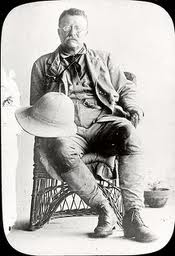 to Go—Recommended Reading for Travelers, Vagabonds, and Dreamers. It makes me want to pack my suitcase and try out a few of the locales for which she has reading suggestions—from Afghanistan to Zambia. Actually, though I’m an adventurous traveler, I’d prefer to discover Afghanistan and Zambia as an armchair traveler, but the book offers plenty between A and Z for just about anyone interested in the literary side of travel. Right now I’m looking at the “Veni, Vidi, Venice” section with, yes, lust.
Nancy is probably the world’s most popular librarian; she even has an action figure. She was here in Minnesota a few weeks ago and spoke at the Southdale library and on Minnesota Public Radio. You can listen to her interview on the MPR Web site. (Also, FYI, this isn’t Nancy Pearl in the photo above. It’s Teddy Roosevelt, adventurer extraordinaire.)
She says in the intro to the book that (unlike me) she doesn’t like to travel that much, let alone lust for it. “I’m stymied,” she says, “by the very activities of planning a trip and figuring out an itinerary, choosing dates and what to pack. I’m frustrated by my inability to speak any language except English…. You try finding a Laundromat in Tallinn without knowing Estonian and you’ll soon discover that although everyone has assured you that all Estonians speak at least a rudimentary form of English, that doesn’t really seem to apply to most people over thirty.”
But one of my favorite writers, Bill Bryson, would argue that that’s the best part of traveling. In his book Neither Here Nor There, Travels in Europe, he says, “That’s the glory of foreign travel, as far as I am concerned. I don’t want to know what people are talking about. I can’t think of anything that excites a greater sense of childlike wonder than to be in a country where you are ignorant of almost everything. Suddenly you are five years old again. You can’t read anything, you have only the most rudimentary sense of how things work, you can’t even reliably cross a street without endangering your life. Your whole existence becomes a series of interesting guesses.” I’m looking forward to seeing him tomorrow at Pen Pals.
The language problems can be the least of traveling disasters. Book Lust to Go has a section that cracks me up: “It Seemed Like a Good Idea at the Time.” Who hasn’t had a few mishaps while traveling? They make the best stories. But these books will make most travelers’ problems and pitfalls look like a day at the beach. Books such as Jim Malusa’s Into Thick Air: Biking to the Bellybutton of Six Continents (think insects, extreme weather and landmines.) Also, W. Hodding Carter’s Westward Whoa: In the Wake of Lewis and Clark. To that I’d add Candace Millard’s River of Doubt: Theodore Roosevelt’s Darkest Journey about his unendingly horrible trip down a tributary of the Amazon, a trip full of treacherous guides, starvation, man-eating fish, malaria and much more. At one point Roosevelt told his son, Kermit, to just leave him there to die. Really, that’s where I draw the line. So much suffering is just no fun. Nancy Pearl prefers to be a virtual traveler through the pages of a book. If all trips were as bad as Roosevelt’s, I’d be happy to join her for an armchair adventure.
 Off The Beaten Page Travel