Tag Archives: book club

Book Club When You Haven't Read the Book

I just ran across a great post from Jeff O’Neal on the blog “Book Riot.”  It’s called “7 Ways to Fake it at Book Club.”  That title cracked me up because at some point just about everyone in a book group has had the problem of not having read the book in time for the meeting.
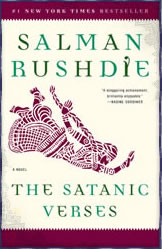
It seemed a particularly pertinent topic because my book club just read Salmon Rushdie’s The Satanic Verses, which is a slog, to say the least.  Even the person hosting the group didn’t finish it.  It’s a great book, won many awards, and Ayatollah Khomeini issued a fatwa against Rushdie (urging Muslims to kill the author) because the Ayatollah found the book blasphemous. The Satanic Verses is full of symbolism, dreams, commentary on the life of immigrants and much more, so it seemed like a great idea when we were choosing books. Still, for most people, it turned out to be a dense book that’s too easily put aside for all the activities of everyday life.

We could have used some of O’Neal’s tips, which include: read the first seven and the last seven pages, be bold and ask the first question, things like, “So, what did everyone else think of the book?” I particularly admire strategy five, “Strategic Proximal Absence,” That means,

When the conversation turns from pre-game chatter to direct discussion of the book, get up and go find something to do in the kitchen, but keep an ear out. Don’t stay in there for an hour, just wait until someone says something you can glom onto. Rush in like you didn’t want to miss this part and ask for a recap. This should give you time to come up with a quick something to say. Plus, your wine will be topped off.

To his suggestions, I’d add: think of other books with similar themes that you have read.  It always seems smart to compare and contrast; it sounds like you know what you’re talking about.

I’m in two book clubs and both are pretty serious about what we read. But, one reason we’ve been together for years and years is that we have an understanding that everyone won’t have read the entire book every time. In The Satanic Verses case, we all admitted that we hadn’t finished it. With that admission, we found common ground in discussing why it was difficult to get through.  And, with a bit of research on Rushdie, the fatwa, and some help from Spark Notes, we had a great discussion of the book without having read it–not quite as good as the real thing, but close.  …. And we all had our wine topped off.

National Book Festival Podcasts

The National Book Festival takes place on Saturday, September 24 and Sunday,

If you can't make it to the National Book Festival, you can take advantage of podcasts from authors who will appear there.

September 25, 2011, on the National Mall in Washington, D.C.
 It’s a bit of readers’ heaven, with discussions and readings from authors including Toni Morrison, Sherman Alexie, David McCullough, Russell Banks, Edmund Morris, Michael Cunningham, Jennifer Egan… the list goes on and on.

But for those who can’t make it to the actual event, the Library of Congress, which sponsors the festival, is offering podcasts from some of the authors who are appearing at the event this year.  For avid readers and for book clubs the National Book Fest site is a great way to get ideas for your next reading list.  And, listening to these podcasts offers interesting insight from these authors and a way to go a bit more in depth for your next reading discussion.

Guns and Book Clubs: What's the Connection?

I laughed this week when I heard a story on National Public Radio about how gun

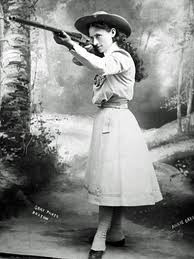
Women have been gun enthusiasts since the days of Annie Oakley, but I'm intrigued by the idea of a book club at the shooting range.

makers have “set their sights” on female buyers and that women make up a growing percentage of gun owners.  One of the women they interviewed goes to the shooting range—with her book club.  One wonders what they could be reading to inspire gun training… self –empowerment books? Violent books about women being attacked? Westerns?

I have to admit I’ve never shot a gun myself, but I don’t have any objection to gun training and I would go to a gun range if someone really wanted me to go with them, just for the experience of it. Moreover, I don’t think gun ownership certainly should be the exclusive domain of men, but that story really piqued my curiosity.  Why would a book club go to a shooting range?

That prompted me to go on line for a little investigation and of course it led me to a huge array of books on the topic of women and guns, not to mention this great photo of the Jane Austin Book and Gun Club.

My book club(s) have gone to movies, dinner, cabin weekends, spas and all sorts of jaunts together.  I spoke with one woman whose book club goes on a fishing trip every year, but I haven’t heard about shooting together.  Guns and books seem such an unlikely pairing.  I know that some book groups have difficulty keeping their discussions under control and because one or two members tend to dominate the discussion.  Or, they may disagree about what book to choose or stray from the discussion too often.  Packin’ heat might be one way to keep them in line.

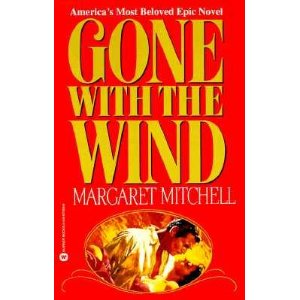
Does this hoop skirt make my butt look big? "Gone With the Wind" at 75

Despite its political incorrectness and my yankee heritage, Margaret Mitchell’s Gone With the Wind is one of my favorite books. It was published 75 years ago–it seems like only yesterday.  Check out National Public Radio’s terrific articles and reports about the book’s 75th anniversary. This occasion makes the book a great choice for book clubs–plenty new to talk about. And, it’s the 150th anniversary of the Civil War, so it’s timely. Be sure to read Pat Conroy’s chapter about Gone With the Wind in his book My Reading Life.

I may be a fan of the book, but I’m nowhere near as devoted as a group of hard-core GWTW fans called the Windies who the New York Times describes as “so ardent that recreating the burning of Atlanta in an airport hotel banquet room is not out of the question.”  I can’t join them.  It’s just too hot for a hoop skirt.

Art Museum Book Clubs

There’s been much gnashing of teeth and wringing of hands about the decline of reading, diminishing book sales, and the “death of print,” but there’s no doubt that books clubs are thriving. It’s hard to know precisely how many book clubs there are because they are often informal groups. However, according to Publishers Weekly there are an estimated seven million such groups in the U.S. and that number is rising.

Art museums across the country are offering book clubs that combine literature with tours through their galleries. Blue Arabesque by Patricia Hampl is on the reading list at The Minneapolis Institute of Arts.

Some organizations, art museums in particular, recognize the power of book clubs and the potential of readers in general as a huge target for their marketing efforts. From the Delaware Art Museum to the Art Institute of Chicago (I love the name of their group, “Reading Between the Lions”) to the Santa Monica Museum of Art, museums are conducting book-based tours and book clubs that capitalize on the notion that reading can make other aspects of life come alive.  Debbi Hegstrom, associate educator for the docent program at the Minneapolis Institute of Arts (MIA) says, “There are unlimited connections between art and literature. This is another way to promote the vision of the MIA, ‘Inspiring wonder through the power of art,’ to a specific but potentially very large audience. With the current popularity of book clubs, it seems like a logical way to tap into the existing interest and bring more people to the museum.”

Formats vary.  Some art museum reading groups revolve around special exhibits or a featured work; others focus on art-related reading in general, be it fiction or non-fiction. Some require museum membership; others, such as the MIA, are open to anyone. All provide great reading ideas and opportunities for book club field trips. At the MIA, museum tour guides have been presenting book-related tours for four years, as requested by organized book clubs, but a newer program, which is open to anyone on a drop-in basis, has been running for three months. Men, women, young adults to seniors participate.  Says Hegstrom, “The titles usually have something art-related but not necessarily. Guides can use artworks in the museum to explore themes presented in a book. Our goal is to include one fiction and one non-fiction title each quarter, with at least one of the books relating specifically to art or artists.” This summer they’re tackling The Savage Garden by Mark Mills, and Blue Arabesque by Patricia Hampl, a fantastic Minnesota writer.

What’s the common thread between books and art? Hegstrom says, “Literature and the visual arts are both creative expressions of the human spirit. To experience both media based on related topics and to share the experience with others brings depth to both. Books become the reason to get into the galleries and talk about a shared experience—in this case, the literature. I think it’s a way to reach some people who might not otherwise visit, but also to strengthen existing relationships. On tours, we are very interested in how people make personal connections to works of art. This is another avenue to help people build those connections.”

So, if you’re a local or a book lover on vacation, you’ll feel welcome at the MIA’s book tours which take place on first Tuesdays of every month at 11:30 a.m. and first Thursdays at 6:30 p.m. Also, for a list of what museums are reading and more information on the connection between art and literature, check out the Hol Art Books site.

Says Hegstrom, “We hope to expand titles, age groups, and partnerships in the coming year. Sometimes the subject matter and discussions can be serious, but in the end what we love to hear is, ‘Wow, that was really fun.’ “

Ethics and Henrietta Lacks

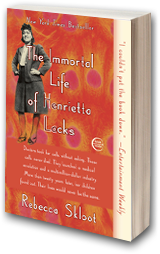
I recently attended a gathering at the University of Minnesota, through its Learning Life series, where Jeff Kahn, director of the University’s Center for Bioethics, discussed Rebecca Skloot’s The Immortal Life of Henrietta Lacks. For anyone who hasn’t read Skloot’s huge bestseller, here’s the Amazon description:

Henrietta Lacks was a mother of five in Baltimore, a poor African American migrant from the tobacco farms of Virginia, who died from a cruelly aggressive cancer at the age of 30 in 1951. A sample of her cancerous tissue, taken without her knowledge or consent, as was the custom then, turned out to provide one of the holy grails of mid-century biology: human cells that could survive–even thrive–in the lab. Known as HeLa cells, their stunning potency gave scientists a building block for countless breakthroughs, beginning with the cure for polio. Meanwhile, Henrietta’s family continued to live in poverty and frequently poor health, and their discovery decades later of her unknowing contribution–and her cells’ strange survival–left them full of pride, anger, and suspicion.

Kahn started the evening by admitting that Skloot had contacted him when she was doing research for the book and he told her that she shouldn’t bother to write the story, everyone already knew about HeLa cells.  It’s good she didn’t take his advice. As a science writer, I admire Skloot’s tenacity, not only in ignoring the naysayers, but also in winning the trust of the Lacks family to get their story; it took her ten years.  I also admire the way she has woven together both the science and human-interest sides of the story to make a really readable book.  That’s the biggest challenge for science writers because straight science is really, really dull. Some people at this session thought Skloot had become too involved with the family and inserted herself into the story too much. I disagree.  A personal relationship was necessary to gain the confidence of the family and it seems like she has taken care not to exploit them. In fact, she donates a portion of her book’s proceeds to the Henrietta Lacks Foundation, which she created to provide financial assistance to needy individuals who have made important contributions to scientific research without their knowledge or consent.  That should be a fairly sizable amount of money because Skloot’s book has been on the bestseller list for months and Oprah has bought the option for a movie.

Kahn offered a bit of background on how researchers have exploited disadvantaged people.  Some experiments were quite barbaric.  These include the Tuskegee Institute study of untreated syphilis in black men, an experiment at the Willowbrook State School (on Staten Island) in the 1960s which exposed mentally retarded children to hepatitis, and another 1960s experiment at New York’s Jewish Chronic Disease Hospital in which vulnerable patients were injected with cancer cells.  These have all led to a mistrust of healthcare among groups who have been exploited. We discussed how slowly laws regarding consent, privacy and other ways of protecting human research subjects lag behind the science.  During Henrietta Lacks’s time, there were no such laws.

Here are a few other questions to think about if you pick up the book:

-Do you think the Lacks family deserves some financial benefit from Henrietta’s cells?Courts have ruled that it’s not the cells that have value in such situations; it’s the intellectual property created by science that has value.

-How is this any different than selling organs? The only person that doesn’t receive a benefit from the current transplant system is the donor.

-Should companies be able to patent and profit from a person’s DNA?

-Are we appropriately concerned with the ethics of using animals in scientific experiments?

-What ethical considerations and laws have changed since the 1950s?  What have we gained as a matter of morality?

As bioscience moves forward with increasingly complex technology, ethicists such as Kahn will have plenty to keep them busy.  To me, the saddest and most challenging ethical issue of this story isn’t as much about science as it is about education and the appalling knowledge gap between rich and poor. Especially in health care, ignorance puts the uneducated at a great disadvantage. That’s an issue for which we are all ethically responsible.

Elizabeth Bennett or Lisbeth Salander? We may not agree, but reading unites us—no matter where we are.


“How was work today?” “Same old thing.”

“What did you do in school today?” “Nothing.”

These frustrating attempts at interaction take place between spouses and between children and their parents every day. It can be a struggle to engage, even if you have plenty of time over the dinner table. So, imagine what it’s like when
deployed soldiers and their families have just a short time to speak to each other.

Alison Baverstock, who is married to a British soldier stationed in Iraq, realized that her family was struggling to relate to one another during phone calls because of the difference in their daily experiences. She told the Guardian, “When your husband rings up from Afghanistan or Iraq, you have a very limited time to talk, but sometimes you just don’t know what to talk about. Your existence can seem quite humdrum in comparison to theirs – and you can’t ask them what they are doing [because military details are secret].”

She found an answer in books. “Being able to talk about a book we’re both reading is great because it gives us some common ground.” Consequently, this March she’s launching The Reading Force, a project designed to bridge the divide between military personnel serving overseas and their families at home by encouraging them all to read the same books. Reading Force will encourage groups of family and friends of soldiers to commit to reading the same book, and recording their thoughts about it – whether by letter, email or in a drawing – in a scrapbook. Those away on tour will also get involved, helping families feel connected and to bond again properly when the tour of duty is over.

Reading is at the core of another project that brings military family members closer, United Through Reading, which has been around since 1989. Through this program, soldiers bond with their families by reading books aloud, recording their reading on DVDs and sending the DVDs home.  So, it’s like a virtual bedtime story. The organization has similar programs for grandparents who live life far away from their grandchildren and for parents who are incarcerated or in treatment.

Reading the same books provides common ground and creates community through shared experiences and ideas. Colleges and universities see the value in this concept and often assign all of the incoming freshman the same book to read before they arrive on campus, thus putting everyone on “the same page,” at least a little. The “one book, one city” programs embraced in Seattle, Chicago and many other communities across the country have the same goal. Check out Chicago Library Foundation’s One Book, One Chicago reading list, even if you don’t live in Chicago.

No matter how noble the mission, not everyone sees the value in the idea of entire communities reading the same thing. Harold Bloom, the country’s most prominent literary critic told The New York Times in 2002, “It is rather like the idea that we are all going to pop out and eat Chicken McNuggets or something else horrid at once.’’

Moreover, choosing a book to read together can create as much dissention as harmony. Entire committees meet to choose the right book for the programs in Seattle and Chicago and a book club can end the evening with everyone in a huff after wrangling over the book choices.  I love discussing books with my family, but they’re all male, even the dog, and they each would rather have a root canal than discuss Jane Austen with me. We have found common ground in books like Cormac McCarthy’s The Road and Stieg Larsson’s Girl With the Dragon Tattoo and the rest of Larsson’s trilogy (over which you can start up a conversation with just about anyone in the world).

Okay, I can see why Larsson’s Lisbeth might be a more attractive character to guys than Austen’s Elizabeth. So, we compromise and end up with a mutual reading experience that brings us together for a while–far more satisfying than McNuggets.

Just Kids: Touring the Lower Manhattan Art Scene with Patti Smith and Robert Maplethorpe

I just finished reading Patti Smith’s National Book Award-winning memoir, Just Kids, the story of her life with the artist and photographer Robert Maplethorpe, a life dedicated to art and to each other. Smith and Maplethorpe met in New York in the late 1960s, while they were in their early twenties and through most of their journey together they lived like stereotypical starving artists—homeless, jobless, hungry, and itching from various vermin.

Of all her talents—art, punk rock, poetry—I’d say Smith is best at writing, which she demonstrates in this beautifully crafted memoir that’s hard to put down. I’m always fascinated with how writers, particularly memoirists, pick and choose the details they include in their stories.  Smith offers less a photographic view than an impressionistic view of their lives, weaving together some (mercifully not all) of the seemy side (she seems surprisingly unfazed at the possibility of contracting gonorrhea from Maplethorpe) with fascinating encounters with the artists of the day including Jimi Hendrix, Janis Joplin, William Burroughs, Andy Warhol and Allen Ginsberg.

The book offers not only a fascinating and tender look at their relationship but also a tour of the Manhattan in the last period of 20th-century artistic ferment. Many hot spots such as Max’s Kansas City are long gone, and gentrification has pushed the art scene into the Meatpacking District, Brooklyn and beyond. Yet, there are still places that carry on the bohemian tradition, though like most of the parts of the city, they’re cleaner, nicer and more expensive than in the 60s. The biggest change has been in the Times Square area, which now fills with crowds of tourists and Disney characters instead of hustlers, addicts and panhandlers.

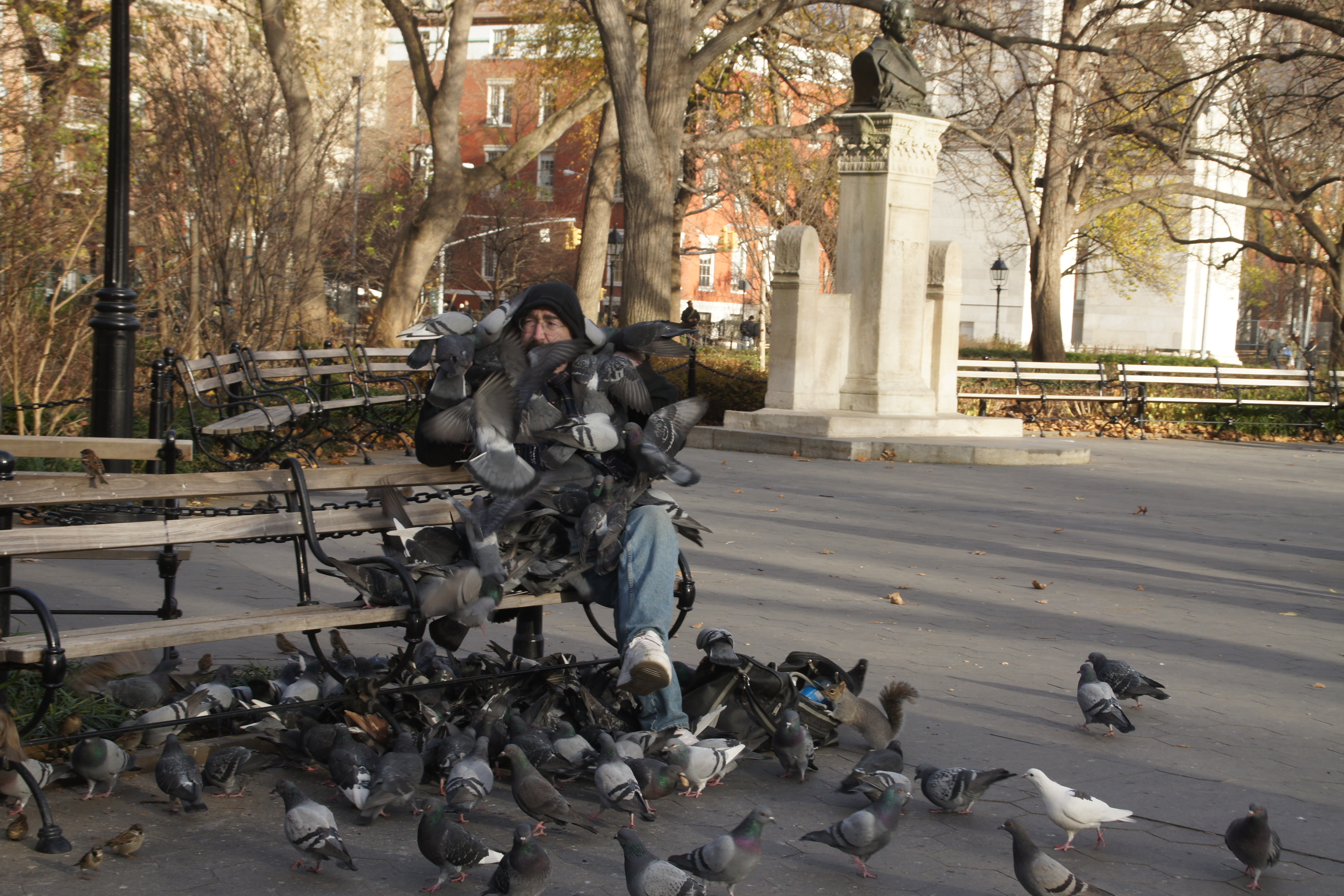
Ditto for the iconic Washington Square Park, which was refurbished over the last couple

Washington Square Park has been refurbished....
...but still has its share of crazy people.

of years. Not to worry, there’s still enough questionable activity there to make it seem bohemian.  Smith tells the story of a couple of tourists who saw her and Maplethorpe hanging out there.  One asked the other if they were artists and hence people they should photograph. The other said no, they’re “just kids.”

You can still go to Coney Island as the pair did when they could only afford one hot dog at Nathan’s. And, if you’re particularly dedicated to experiencing the life at the Hotel Chelsea  www.hotelchelsea.com where Smith and Maplethorpe lived for many years, you, too, can stay there.  The rates are exponentially higher than in the early 70’s, but from what I can see from TripAdvisor reviews, you can have an authentic Chelsea Hotel experience—complete with the bugs, stains and loud music and with the same furniture and carpeting from Smith and Maplethorpe’s day.  Better, perhaps, to fork out $40 for the occasional tour the Chelsea offers and actually sleep in another hotel.

The St. Mark’s Poetry Project where Smith performed is still going strong. To get another taste of the poetry scene, head to the Bowery Poetry Club and Café, especially on Tuesday nights for the Urbana Poetry Slam. If you get a chance, eat dinner at DBGB, across the street (by contrast, new and very trendy).

Looking for more of the history of Greenwich Village? Take a Big Onion Walking Tour, which travels into the tiniest and most charming streets of Manhattan, so unlike the concrete jungle beyond the Village borders.  These are the haunts of William Faulker, Dylan Thomas and Jack Kerouac and his Beats buddies. Some of the buildings, which date back to colonial times, served as slave quarters and servants’ houses but are now the most expensive pieces of real estate in the city.

Top off your walking tour with a latte and a giant cookie at the cozy Grey Dog Coffee Shop on Carmine Street.   I love that they serve my latte with the froth in the form of a dog’s paw print. Clearly, I don’t have what it takes to be a starving artist.

If You Love Your Books, Set Them Free

I usually think about books and travel, not books that travel. However, I’ve been looking at a Web site called BookCrossing which offers what looks like a useful option for people like me who must periodically purge their piles of books to keep from being featured in an episode of that “Hoarders” show on A&E.

This site allows you to register the books you want to pass on. You put a label in each book with a BookCrossing code and then release it in a variety of ways. You can pass it on to someone you know or send it to a fellow BookCrosser who is looking for that book. You can take the book(s) to a designated “Crossing Site.”  For example, in the Minneapolis area where I live, there are 41 books are floating around, free for the taking, at sites such as coffee shops, a Lutheran church, Eden Prairie Mall, and a Wells Fargo Bank office. Or you can release the book “into the wild,” that is, just lay it around somewhere. Ideally the person who picks it up will see the label, go to the Web site, and register where the book is and who has it. You can also request book that you’re looking for and see what happens.

I’m very big on supporting bookstores and I use the library all the time. Yet, I find this idea intriguing, a way to share books and make contact with fellow readers all over the world, and better than “abandoning” my books at Goodwill or a used book store. (For defenders of the printed book: This is one of the things that paper books can do that e-books can’t.) I haven’t tried Book Crossing yet, but it would be interesting to set up a place to leave books with specific people in mind—children, English language learners, homeless people, moms, soldiers.

It seems like you have to be fairly motivated to get involved in all this, but apparently quite a few people find it worth the effort. The site reports 850,000 active BookCrossers and almost seven million registered books traveling around 130 countries. As one user said, “I can’t wait to see where the books I have read go… to see where the ones I discover are from… (it’s like being on a continual treasure hunt!).

I'm Not Enjoying This Book–How Many Pages to Read Before You Quit

I just ran across the answer to a question that people in my book club regularly ask, “I’m not enjoying this book.  How much should I read to give it a fair chance before I toss it aside and take up a book I really like?” So many books, so little time.

The answer is Book Lust Author Nancy Pearl‘s Rule of Fifty. She says: “People frequently ask me how many pages they should give a book before they give up on it. In response to that question, I came up with my “rule of fifty,” which is based on the shortness of time and the immensity of the world of books.  If you’re fifty years of age or younger, give a book fifty pages before you decide to commit to reading it or give it up.  If you’re over fifty, which is when time gets even shorter, subtract your age from 100—the result is the number of pages you should read before making your decision to stay with it or quit.  Since that number gets smaller and smaller as we get older and older, our big reward is that when we turn 100, we can judge a book by its cover!”

Another suggestion:  start skimming.  At least you can participate in conversation about the book.  I just did that with Elizabeth Kostova’s The Historian.  It’s a vampire story, so you’d think it would hold one’s attention, but I it so convoluted, long, and full of explanatory letters, I became very impatient.

Or, take the book chunk at a time.  I just started thumbing through the gigantic Autobiography of Mark Twain which is less narrative and more bits, pieces and reflections.  It gives great insight into Twain’s character and I’m going to be quoting from it a lot.  I’m prone to stick with this volume because hefting it gives me enough exercise to forego the gym.  My aching biceps.