I was delighted to see this coverage of Off The Beaten Page in the Minneapolis Star Tribune. I hope it inspired others to make their travels “literary travels.” Check out the article, Literary traveler goes ‘Off the Beaten Page’ and please be sure to tell your friends.
The mysterious House of Seven Gables in Salem, Massachusetts
Salem, Massachusetts, makes a nice day trip from Boston and if you’re there, a stop at the House of Seven Gables is a natural for lit lovers or anyone who likes the occasional glimpse of really old colonial homes. Author Nathaniel Hawthorne’s cousin, Susanna Ingersoll (and other ancestors who played a part in the Salem Witch Trials of 1692), lived in the house and he visited there frequently. He stated that his book, The House of Seven Gables, was a complete work of fiction, based on no particular house. Nonetheless, as you tour the tiny, dark rooms typical of the era in which it was built (the late 1600s), it’s easy to see how such a house could set the author’s imagination rolling. The site also offers a chance to tour the house in which Hawthorne was born (which was moved to this site) along with several other buildings of that period.
If you haven’t read The House of Seven Gables, the novel follows a New England family and explores themes of guilt, retribution, and atonement, with overtones of the supernatural and witchcraft. For me, the book doesn’t compare to Hawthorne’s classic, The Scarlet Letter. However, it was an inspiration for the horror fiction writer H.P. Lovecraft who called it “New England’s greatest contribution to weird literature.” That seems a backhanded complement to me.
You can tour this tall ship at the Salem Maritime National Historic Site.
While you’re in Salem, I also recommend stopping at the Salem Maritime National Historic Site, a short walk from the House of Seven Gables. The National Park Service operates it and you can wander through old wharf buildings, the Custom House where Hawthorne worked when he wasn’t penning famous novels, and other buildings of the colonial era.
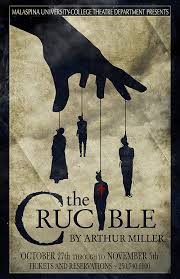
Salem was, of course, the home of the famous Salem Witch Trials which were the focus of Arthur Miller’s classic play, The Crucible. The National Park Service Visitor Center (2 Liberty Street) is a great place to get quality background on that incident. It’s ironic that Salem has made a cottage industry out of the witch trials when our puritan ancestors were so thoroughly opposed to witches. Unless you’re a fan of super-tacky witch paraphernalia and occult museums, stick with the Park Service displays on the subject and skip the other witchy tourist traps.
Dreaming of balmy weather and tropical sunsets in Miami Beach, Florida.
January. It’s the same routine every year. The relatives go home, the last toasts to the new year have been made, and I’m feel slightly blue–partly because my kids have left and partly because it’s been crazy cold here in Minnesota. It didn’t get above -11 on Monday. I’m talking Siberia cold.
Though it’s a bit of a letdown when the holiday frenzy is over, the quiet time of January provides a time to reflect on what I’ve done over the last year, new things I’d like to do this year, and after enough procrastination, to get fired up to do a few of those things. Since it’s been too frosty to go out, I’ve had plenty of time to hunker down and “reflect” (okay that’s my word for not getting to work). I looked back at the first post I made on this blog, which was called “Book Club Traveler” then, and I’m glad I took the time to revisit it. I always have giant lists this time of year of all the things I wish I had accomplished, a lot of “should-have-done this and why-didn’t-I-do-that,” things I need to do now. But looking back a couple of years at those first days of blogging, I’m feeling pretty good, optimistic even. My goal was to encourage readers to take their love of literature to the next level and actually travel to the places they read about. I concluded my first post with: “So, this blog will explore the places where literature and travel intersect, how to escape with a good book and understand the places we travel, with or without a book group, through the eyes of authors who have gone there before us. Let’s get out of the living room and hit the road.”
I got enough positive feedback on the concept and enough comments like, “I wish my book club would do that,” that I gradually I came to believe that the concept was worthy of a book. And, as a result, Off The Beaten Page: The Best Trips for Lit Lovers, Book Clubs and Girls on Getaways (Chicago Review Press) came out last May, hence the new name of the blog. The book features 15 U.S. destinations with essays, an extensive reading list, and a detailed itinerary for each. People always ask what was my favorite destination. In January, my favorite getaway is South Beach/Miami, Florida. I’ve written several posts about that trip like this and this. It was just arduous doing research there as you can see from this video. Notice that no one is wearing bulky sweaters or long johns.
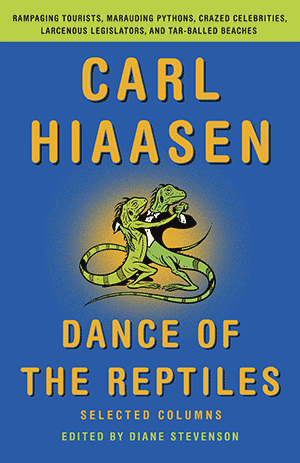
However, if you’re dreaming of Florida right now, but not exactly getting there as soon as you’d like, pick up any book by Carl Hiassen for a crazy look at south Florida, especially Miami; Susan Orlean’s The Orchid Thief; Peter Mathiessen’s Shadow Country about the Florida frontier; or Karen Russell’s Swamplandia! I’m snuggled in with new books to read and dreaming up potential new adventures for the year based on those books. One benefit of travel and reading is that even if I’m home in the deep freeze, I can conjure up previous tropical sojourns to warm my heart if not my fingers and toes.
If you think reading is a solitary pursuit, you need to go to a book festival.
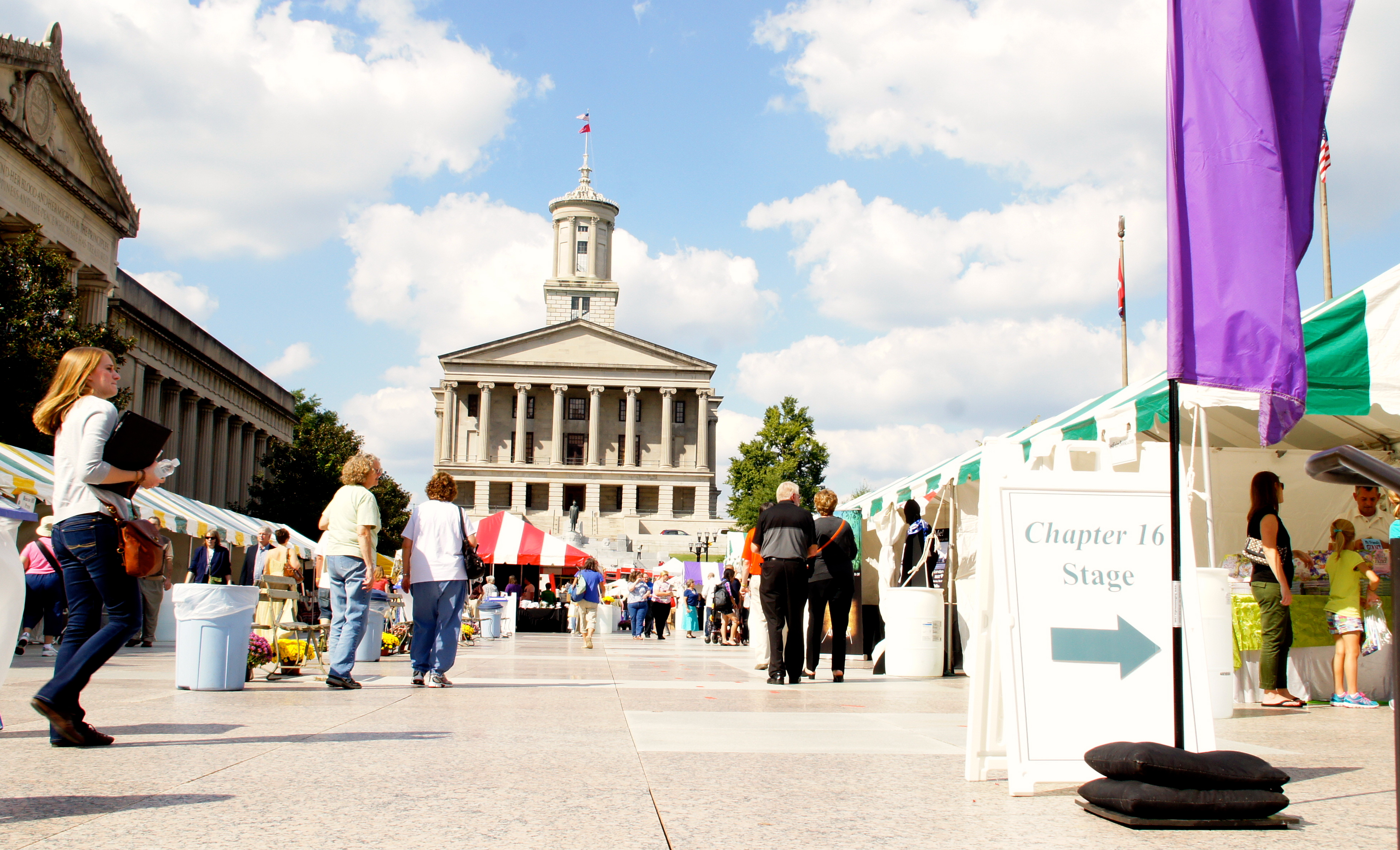
Southern Festival of Books on the Leglislative Plaza in Nashville, Tennessee
I moseyed down south to the Southern Festival of Books in Nashville a couple of weeks ago and found myself amidst about 30,000 kindred spirits. I strolled among rows of tents full of books and publishers–like an art fair for book lovers–set up on the capitol city’s Legislative Plaza. Program in hand, I had the difficult task of choosing among the 212 sessions, three performance stages, and 325 authors speaking and signing their books during the three-day event.
Sessions (usually about an hour) took place in Nashville’s gorgeous public library,
So many books and authors, so little time.
Legislative Plaza rooms, and in War Memorial Auditorium. Authors talked about their books, like a book club discussion. In fact, book clubs showed up to ask questions and share their enthusiasm for books their groups had read. I especially enjoyed hearing William Landay talk about his experiences as a prosecutor and the ideas that went into writing his bestseller, Defending Jacob. Another of my favorites, Meg Wolitzer, read from her book The Interestings and talked about how her own background influenced the story. But, the fest offers something for lovers of every literary genre, a look at regional writers who you may not know, as well as appearances from big name writers who this year included Bill Bryson, former Vice President Al Gore, Rick Bragg, Roy Blount, Clyde Edgerton, Chuck Palahniuk and others. It was a little slice of heaven for book enthusiasts and the throngs there offered clear proof that, though the publishing industry is changing dramatically, readers are more passionate than ever about books and relish the opportunity to connect with authors and with their fellow readers.
Encouraging the Readers (and Writers) of the Future
I was also impressed with the Festival’s efforts to boost childrens’ interest in literature. It offered sessions for teachers, parents, and young readers from toddlers to YA. Take for example, panels such as “Building Kids Imaginations through Picture Books: Museums, Libraries, Engineers, Mice and More” or “Zombie Tales of the Undead for Teens and Tweens,” or singer Janis Ian reading her book, The Tiny Mouse. In fact, about 60 of the featured authors this year write for children and teens. The biggest event: kids screamed for Rick Riordan (author of the Percy Jackson and the Olympians series) like he was a rock star. Read more about the Festival in Publishers Weekly.
If this sounds a little too book-obsessed, for a weekend in the Country Music Capitol, I want to assure you that we took advantage of the other great stuff to do in Nashville. Exhibit A, my new cowboy boots, perfect footwear to wander up and down Broadway, Nashville’s main music thoroughfare, where country tunes pour forth night and day.
You never know who you’ll meet on the street in Nashville.
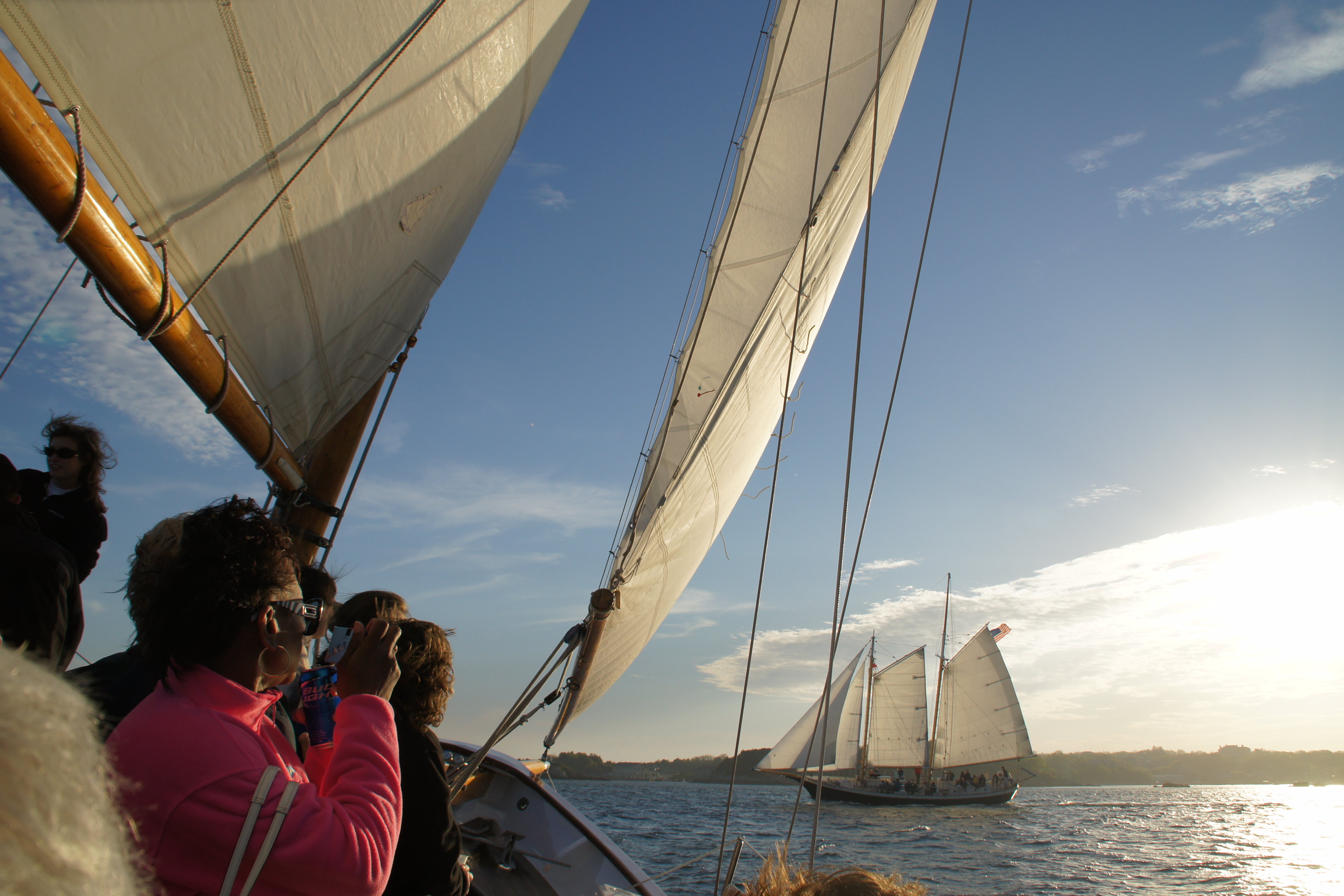
Fall is the best time for literary travel just about anywhere, including Newport, Rhode island.
If you’re a traveler, fall, not Christmas, is the “most wonderful time of the year.” Same sites but fewer crowds, cooler temps, and often, lower prices. It’s the perfect time to go so many places, you may find it hard to choose a destination. The answer lies on your bookshelf. Whether they’re classics or “beach reads,” your favorite books can offer guidance and inspiration for a “lit trip” to see the sites of the stories, absorb the environment that inspired the authors, and even walk the paths of fictional characters. Literary travel allows you to extend the experience of a great book and expand your understanding of your destination. Reading and travel enhance each other, and one taste will leave you yearning to go back for more. Best of all, you don’t need to head for Hemingway’s favorite Paris haunts or Jane Austen’s English countryside to take a lit trip. Opportunities for book-based travel abound in the U.S., too, and many are at their best in fall.
California Wine Country – Vintage Reading
Harvest time in California’s wine regions, typically from mid-August through October, overflows with vibrant golden yellow and crimson colors and the trucks rumbling by overflow with grapes ready for the crush. M.F.K. Fisher captured the delights of Napa and Sonoma where she lived and wrote her classic essays on food, wine, and life. Jack London also loved the Sonoma area where he lived and wrote in his later years. And, for fans of another type of grape, The Grapes of Wrath (which has absolutely nothing to do with wine), the National Steinbeck Center in Salinas, is a short jaunt from wine country, making literature and wine the perfect blend for fall travel.
Read: M.F.K. Fisher, Musings on Wine and Other Libations, (Anne Zimmerman, ed.)
Jack London, Valley of the Moon (another name for Sonoma),
For more contemporary reading, try James Conaway, Nose, and Rex Picket, Sideways.
Explore: the vineyards of Napa and Sonoma counties, and take a side trip to the National Steinbeck Center in Salinas (www.steinbeck.org)
Stay: L’Auberge Du Soleil, Rutherford (www.aubergedusoleil.com)
Eat: pack a picnic and enjoy it on the grounds of your favorite winery or in Jack London State Historic Park in Glen Ellen www.jacklondonpark.com
Events: Fall in wine country means special celebrations of wine and food such as Flavor! Napa Valley in November (flavornapavalley.com), vintner dinners such as those at Grgich winery (grgich.com). Schramsberg winery in Calistoga offers special camps in fall and spring for wine and food lovers (www.schramsberg.com/news/campschramsberg)
Santa Fe – Willa Cather’s Archbishop Comes to Life
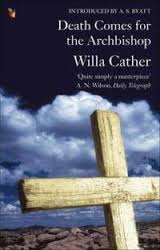
Santa Fe is a sensory fiesta year-round but in fall the aroma of roasting chili peppers adds to the mix. New Mexico’s beauty, dramatic history, and architecture have lured for artists and writers for decades. Among them, D.H. Lawrence (to Taos) and Willa Cather, who captured the drama of the New Mexico environment as she wrote a fictional version of the real-life story of Bishop Jean-Baptiste Lamy, in Death Comes for the Archbishop. Shoppers and art lovers will find equally dramatic adventures in Santa Fe.
Read: Willa Cather, Death Comes for the Archbishop
Explore: Bishop’s Lodge which offers a spa, horseback riding, and a chance to see Bishop Lamy’s chapel and home. (www.bishopslodge.com)
Stay: Inn on the Alameda (www.innonthealameda.com)
Eat: The Shed (www.sfshed.com)
Events: Santa Fe Wine and Chili Fiesta (www.santafewineandchile.org)
Newport, RI – America’s “Downton Abbey”
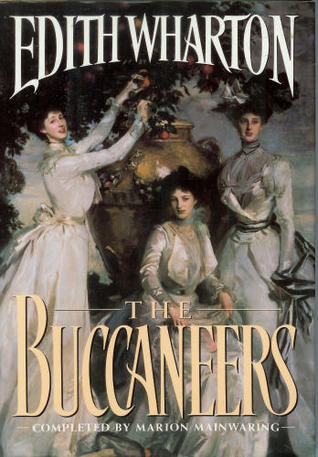
Since the 1800s, America’s wealthiest families have flocked to Newport, Rhode Island, and built summer “cottages” that most of us would call “palaces.” Among them was Edith Wharton, who wrote of her experiences in Gilded Age Newport in books such as The Buccaneers, which is about wealthy heiresses who married into the British aristocracy, much like “Downton Abbey’s” Cora Crawley. You can explore Newport’s Gilded Age mansions as well as its gorgeous seaside sites. The more “off season” you go, the more you can afford live like a Vanderbilt.
Read: Gail McColl and Carol Wallace, To Marry and English Lord
Edith Wharton, The Buccaneers
Explore: Newport Mansions (newportmansions.org)
Stay: Vanderbilt Grace (www.gracehotels.com/vanderbilt) Ask about packages that include admission to the Newport Mansions.
Eat: The Mooring (www.mooringrestaurant.com)
Events:
Polo matches, sailing regattas, or just a hike along Cliff Walk. In Newport you can sample “upper crust activities” or just enjoy the view. (www.gonewport.com)
Nantucket – A Whale of a Trip
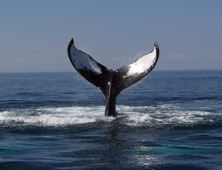
You can’t find a more concentrated dose of New England charm than in Nantucket. And, if you’re a fan of Herman Melville’s whale tale, Moby Dick, you know that Nantucket is the place where Captain Ahab’s ship, the Peaquod, set sail.
Read: Herman Melville, Moby Dick,
Nathaniel Philbrick, Why Read Moby-Dick? and In the Heart of the Sea: The Tragedy of the Whaleship Essex
Sena Jeter Nasland, Ahabs Wife
Or for more contemporary tales, read Summerland and other books by Nantucket resident Elin Hilderbrand.
Stay: White Elephant (www.whiteelephanthotel.com)
Eat: Millie’s. Enjoy the sunset and sample a Whale Tale Pale Ale. (www.milliesnantucket.com)
Explore: Nantucket Whaling Museum (www.nha.org)
Events: The Nantucket Maritime Festival. You’ll hear sea shanties sung, see harpoons thrown, and boats raced. (www.nantucketmaritimefestival.org)
Driftless in Wisconsin
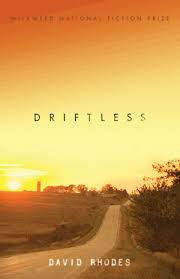
Because of its geology, the Driftless Area of southwest Wisconsin is a place tailor-made for meandering. And the fall colors are reaching their peak in Wisconsin right now. As David Rhodes explains it in his beautiful book Driftless, “The last of the Pleistocene glaciers did not trample through this area, and the glacial deposits of rock, clay, sand, and silt–called drift–are missing. Hence its name, the Driftless Region. Singularly unrefined, it endured in its hilly, primitive form untouched by the shaping hands of those cold giants.” In this area, you’ll meet friendly folks who may remind you of the characters in Rhodes’s book—organic farmers, artists, shopkeepers, and the nice Norwegian lady at the dairy coop. Amish folks sell produce and hand-made wares at roadside stands, making the entire area a giant farmers market through fall. By the end of your trip, you’ll be reluctant to leave. But you can return by reading Rhodes’s newest book, Jewel Weed.
Read: David Rhodes, Driftless and its sequel, Jewel Weed
Stay: Charming B&Bs abound in the Driftless Area. Check out The Roth House(therothhouse.com) and the sister property The Old Oak Inn (theoldoakinn.net) in Soldier’s Grove or Westby House Inn in Westby (www.westbyhouse.com)
Explore: Amish farms and shops (www.downacountryroad.com) and Wildcat Mountain State Park (www.dnr.wi.gov/topic/parks/name/wildcat/) For more Driftless information see driftlesswisconsin.com
Events: Gays Mills Apple Festival (www.gaysmills.org/Apple_Festival)
Literary Travel Isn’t Just for Book Clubs and Girls on Getaways–a guest post from Scott Smith, Edina, MN.
First things first: I’m a guy. I work hard during the week, bleed Maize and Blue sports, track the Wild and Vikes with interest, fire up the grill on weekends and tip back a beer or three in the process. Give me ESPN, a fishing rod, a deck of cards and some Blanton’s, and I’m happy as a clam. I’m not a complete Neanderthal – I do enjoy a good novel now and then, and I love to travel – but I’ve assiduously avoided this “lit trip” phenomenon up to now, largely out of fear of getting my man card revoked.
I’m also a huge WWII history buff, particularly with regard to the D-Day invasion and its
“Les Braves,” a nine-meter tall stainless steel sculpture by Anilore Ban rises from the sand at Omaha Beach near St. Laurent-sur-Mer, France. It honors all those men who landed there to liberate France. The sculpture has 3 elements: 1) Wings of Hope, 2) Rise, Freedom!, and 3) Wings of Fraternity.
aftermath, and I’ve read just about everything I can muster on the topic. Among my favorites, I’ve nearly broken the spine on Stephen Ambrose’s D-Day; my copy of Anthony Cave Brown’s A Bodyguard of Lies is lovingly dog-eared; and, Ben Macintyre’s Double Cross holds the current place of honor on the dresser next to my side of the bed. From my readings, I can name every landing sector in Normandy, the combat units that landed in each, and when. I know that “Hobart’s Funnies” is not an Australian comedy club and that the Falaise Gap is not a dental imperfection.
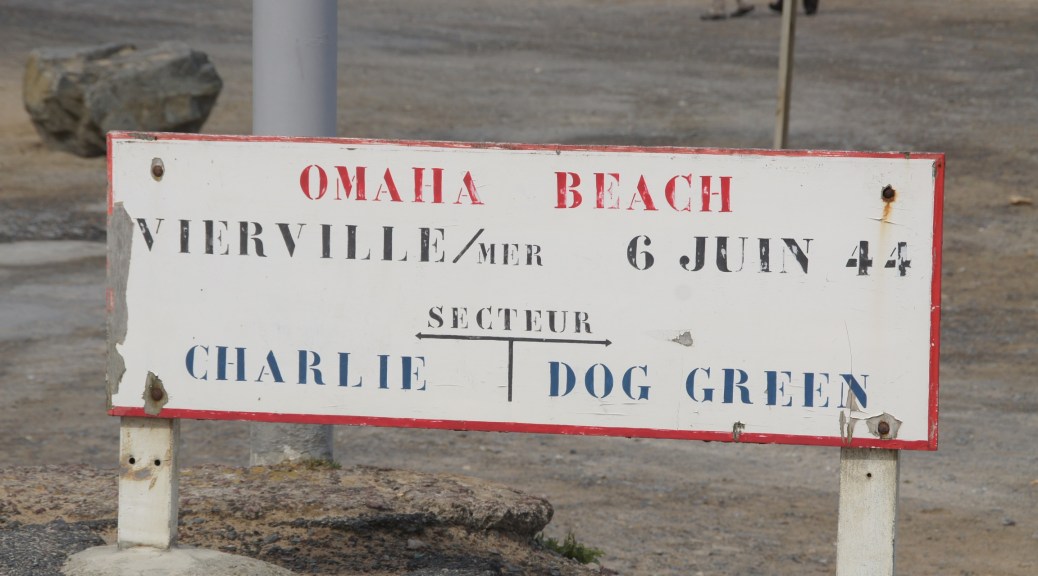
Go to Omaha Beach today, as Terri and I did a few weeks ago, and for the uninformed tourist it’s almost impossible to visualize what happened there nearly 70 years ago. Sure, the ruins of a few German gun emplacements are still there, and a couple of memorials (the one on the beach outside of St. Laurent is particularly striking) remind you of the historical importance of where you stand. Otherwise, the eyes see a gorgeous stretch of white sand, turquoise water just beyond it, children splashing in the surf, and lush green bluffs overlooking the seashore, like some Impressionist painting.
But I saw, and experienced, something entirely different. I saw exactly where the 116th
The American Cemetery, Normandy, France
Regiment’s Company A, National Guarders from Bedford, Virginia, came ashore at 6:30 am on D-Day morning – just a couple hundred yards below the gun emplacement at Vierville that’s now a National Guard memorial – and instantly comprehended why that unit suffered over 90 percent casualties in the space of 10 minutes. I looked on the bluffs and the draws above Omaha and witnessed vicariously the extraordinary leadership of young infantrymen who understood that the original assault plan was doomed and improvised their way to success. I visualized the beach obstacles, the barbed wire, the shingle – all gone today – and marveled at the bravery of those who swam and crawled ashore that day. And standing in the American cemetery in the bluffs outside of Colleville, amid row after row of crosses and Stars of David, I saw the selflessness of and the sacrifices made by the “Greatest Generation” in a whole new light.
And so I’m forced to confess. The umbilical between reading and travel isn’t necessarily reserved for book clubs and gals on getaways – it’s there for us XY types too. Maybe it’s a jaunt to Key West, to take in a little fishing with Hemingway’s Santiago. Perhaps it’s that trip to a Wyoming dude ranch with Larry McMurtry in hand. Or it’s a Dodgers game after reading The Boys of Summer. Your call. Like I experienced in Normandy, what you read may give special meaning to what you see. That’s a good thing. And I promise you won’t lose your man card in the process.
From Terri: In addition to Scott’s list of books, I’d add Jeff Shaara’s The Steel Wave, about the D-Day Invasion, which is part his World War II trilogy. It’s a good read, easy to digest.
You’ll find words of inspiration, eerie tales, and New England history on the Babson Boulder Trail, Cape Ann, Massachusetts
Bars and counters are my favorite places to sit in restaurants. There’s something about the combination of close proximity and food that fosters great conversations among complete strangers. And, if I see you sitting next to me with a book, you won’t have time to read it because I’ll won’t be able to stop myself from asking what you’re reading, what it’s about, and do you recommend it.
That happened a couple of springs ago when my husband, Scott, and I were in Rockport,
The New York Times called this is “a true-crime story, an art appreciation course and an American history lesson stitched together, and it succeeds as all three, albeit with a few seams showing.”
Mass., (on Cape Ann, about an hour north of Boston) while I was researching my book, Off The Beaten Page: The Best Trips for Lit Lovers, Book Clubs and Girls on Getaways. There was still a chill in the the air and we were happily slurping down huge bowls of fish chowder at the Red Skiff, a tiny restaurant on Rockport’s aptly named Mt. Pleasant St. (The relaxed pace and the chance to hang out and chat with locals on both sides of the lunch counter without a line if diners behind you, and of course lower prices, are a few of the many charms of off-season travel.) I noticed that two of our lunch counter companions were discussing a book, so I had to barge into their discussion and ask about it, which led to questions about where we were from and what brought us to Rockport. Turned out the two gentlemen were members of the local sheriff’s department enjoying their day off. When one heard about my project, he grabbed the book from his friend’s hands and said, “You’ve got to read this book.” It was Elyssa East’s Dogtown: Death and Enchantment in a New England Ghost Town. He said with an air of mystery that Dogtown has had a very strange history. “Say no more,” I said.
That lunch counter encounter was enough to launch me into reading not only East’s non-
Anita Daimant’s The Last Days of Dogtown is a work of historical fiction based on a colonial settlement Massachusetts.
fiction book about a murder in Dogtown, but also Anita Diamant’s fictional work The Last Days of Dogtown (you may have read her best-seller, The Red Tent) and Thomas Dresser’s Dogtown: A Village Lost in Time. After reading those books, I had to go see the place for myself.
Dogtown is a 3,600-acre tract of juniper, bog, and granite with a beautiful reservoir at one end. Early settlers–really early, like the mid-1600s–put down roots in Dogtown, though it couldn’t have been easy among so much rock. A century later as many as 100 families lived in the Dogtown area. But after the Revolutionary War, people figured that fishing might be a better way to make a living than tilling around giant boulders. It’s surprising that it took them that long. By the early 1800s, Dogtown was deserted, but for a few impoverished widows who, like Tammy Younger, the “queen of the witches,” intimidated passersby enough to make them pay her to leave them alone. A few dogs remained, too, which according to some people is the reason for the area’s name.
One thing that’s unnerving about Dogtown is that’s it’s rather hard to find your way around, giving the feeling that at any turn you could become hopelessly lost and eventually end up like Tammy and her warty friends. To explore Dogtown Commons, buy a detailed trail map at Toad Hall Books in Rockport or bookstores in Gloucester and bring along your GPS. You can also take a tour with an expert Seania McCarthy at Walk the Words. With a bit of looking, you can still find the holes that were the cellars of the first Dogtown homes.
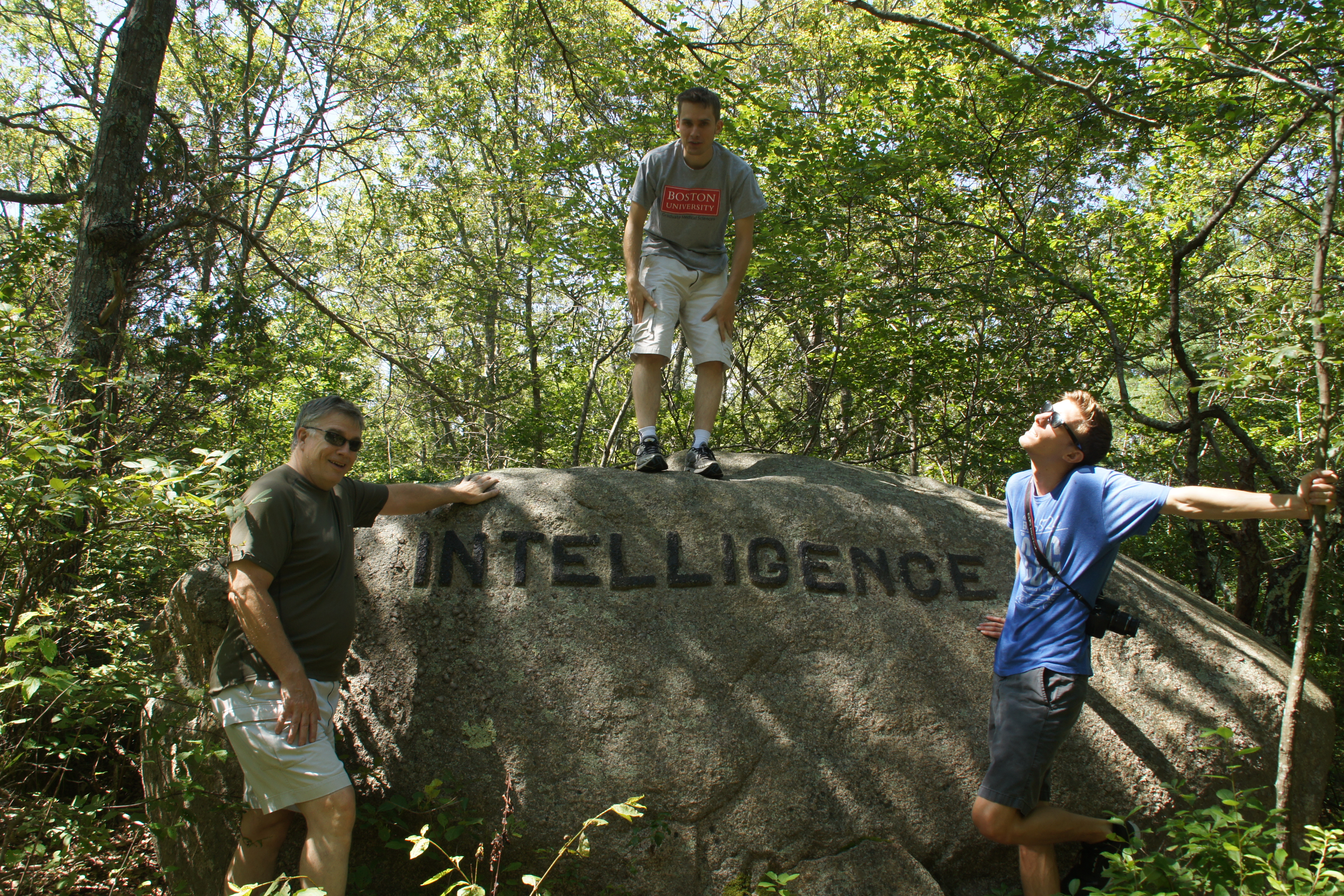
But my favorite hike is the Babson Boulder Trail. During the Depression, millionaire
Intelligence gathering along the Babson Boulder Trail.
philanthropist Roger Babson, the founder of Babson College, hired unemployed stonecutters to carve 24 inspirational words on Dogtown boulders, many on what is now the Babson Boulder Trail. It’s fun, but a tad eerie, to encounter giant boulders at various points on the trail with inscriptions such as “Industry,” “Kindness,” “Be On Time,” and “Keep Out of Debt.” My favorite: “Help Mother.”
All of this history and mystery made Dogtown a favorite source of inspiration for the painter Marsden Hartley who captured the place in powerful, primal paintings such as “Rock Doxology.” He said, “A sense of eeriness pervades all the place…. [It is] forsaken and majestically lovely, as if nature had at last formed one spot where she can live for herself alone.” Read the books and go see for yourself.
Dogtown was the subject of many works by painter Marsden Hartley. You can see “Rock Doxology” in the Cape Ann Museum, Gloucester, Mass.
Santa Fe is one of my favorite places. Fabulous art, Native American crafts, great food, shopping, music, and outdoorsy pursuits abound. If you’re traveling with a group, it’s hard to keep everyone together because everything you see makes you want to stop and stare, from the wisteria draped adobe architecture to the fabulous Native American jewelry and even the distinctive high desert sky.
Adobe and wisteria, Santa Fe
Santa Fe’s sky and special light–clear and stunningly bright–is one reason Santa Fe and nearby Taos have attracted writers and artists for decades. Author D.H. Lawrence fell in love with the place. He wrote in “New Mexico,”
The moment I saw the brilliant, proud morning shine high up over the deserts of Santa Fe, something stood still in my soul, and I started to attend… In the magnificent fierce morning of New Mexico one sprang awake, a new part of the soul woke up suddenly, and the old world gave way to a new.
Willa Cather found a similar fascination with the New Mexico sky. In Death Comes for the Archbishop she says
The plain was there, under one’s feet, but what one saw when one looked about was the brilliant blue world of stinging air and moving cloud. Even the mountains were mere anthills under it. Elsewhere the sky is the roof of the world; but here the earth was the floor of the sky.
While Lawrence and Cather painted New Mexico with words, stroll through Santa Fe and you’ll see how countless artists have portrayed the area in oil, clay, bronze and more, which has made Santa Fe the second or third largest art market, depending on who you’re talking to. The city was designated a UNESCO Creative City in 2005, the first U.S. city to be so honored and currently one of only a handful of Creative Cities in the world. In 2009 the National Trust for Historic Preservation named Santa Fe one of the Trust’s Dozen Distinctive Destinations.
You’ll find a concentrated dose of art on the city’s famous Canyon Road, with over one
Truffles the Pig on Canyon Road
hundred galleries, specialty shops, and restaurants. It’s a visual fiesta at just about every turn, and if you look carefully you’ll find something for every budget. Though the galleries would love to have you purchase a work of art, you’re welcome to come in and simply savor what you see for a while.
Cowboys and Indians Santa Fe
Just looking? Santa Fe is also a city of museums with more than a dozen different facilities including the Museum of International Folk Art, The Museum of Indian Arts & Culture, SITE Santa Fe, New Mexico Museum of Art, Museum of Spanish Colonial Art, Wheelwright Museum of the American Indian, Georgia O’Keeffe Museum, Santa Fe Children’s Museum, New Mexico History Museum/Palace of the Governors, and one of my favorites, the Museum of Contemporary Native Arts.
Get a quick education on Ernest Hemingway with a visit to Oak Park, Illinois.
Ernest Hemingway’s personal life was as interesting and adventurous as his fiction. So, while I was in Chicago recently I took a side trip to the lovely suburb of Oak Park, where I visited the Ernest Hemingway House and Museum. For Hemingway fans or if you enjoy books about Hemingway such as The Paris Wife, you’ll find a stroll in the author’s old neighborhood is delightful.
In previous posts, such a the one about A Skeptic’s Guide to Writer’s Houses, I’ve discussed the fact that authors’ homes aren’t as interesting as the places where their books are set. Still, it’s fun to see how an author lived and maybe hear a few stories about family life that may have shaped his world view. For example, when you take the guided tour in the home, you’ll see the little dining room where Hemingway’s grandfather sat with the children for breakfast and encouraged all of them to tell stories. He didn’t long enough to see what sprang from such encouragement.
So, if you’re in Chicago, make a trip to Oak Park to visit the Hemingway family home. Start at the museum at 200 Oak Park Avenue 708-524-5383, www.ehfop.org The home where Hemingway was born is one block north.
Slugger, a natural traveler, loved to be on the move–across town or across the country. Here, he’s waiting for his next adventure.
I’m the world’s biggest dog lover, but I generally avoid “dog stories” because I invariably wind up sobbing. They’re always sad. I’ve never really recovered from reading Old Yeller in grade school. But, I recently discovered author Leigh Brill Singh, a fellow dog lover who has her own dog story, A Dog Named Slugger, about how her service dog transformed her life as a person with cerebral palsy. When I heard how much she travels from her Virginia home to promote her book, “ability awareness,” and the Saint Francis Service dogs that have changed her life, I had to share her story on Off The Beaten Page Travel. Our interview will appear in two parts, so stay tuned for Leigh’s ideas and tips about traveling with pets, whether they’re service animals or not. Before you read this post, grab your Kleenex and check out a video about Leigh and her canines. http://vimeo.com/12630552 And, be sure to check out part two of our Q and A.
Okay, Leigh, I’m tearing up just looking at the cover A Dog Named Slugger, so tell me a bit about your book and why it’s worth getting dehydrated to read it.
A Dog Named Slugger is more than “a dog book.” The story offers an intimate look at what it means to live with a congenital disability. It goes on to reveal how my own life was shaped by cerebral palsy and ultimately re-shaped through my partnership with an amazing Labrador. My first service dog, Slugger, taught me to define myself not by what I had to overcome, but by what I had the courage to become. His message to me was, “I’m here for you. No matter what.” That message inspired me. It gave me hope. Given the challenges so many folks face these days—from economic worries, to the multi-level stressors of war, to threats to health and well-being—we all need hope. That’s a big part of why I wrote A Dog Named Slugger. It’s one way I can pass along some of the many gifts that my big yellow Lab first offered me. Just like the remarkable dog who romps through its pages, the book proves that a gift is most beautiful when it is shared.
Do you have other books in the works?
I’ve been very honored to hear from readers throughout the world who have described A Dog Named Slugger as an eye-opening, entertaining, and uplifting read, one they’ve read over and over until the spine is creased and the their favorite pages are “dog-eared.” Readers ask, “What happens next?” and I am hard at work on the answer. My second book will pick up where the first ended and I’ll also be introducing some new friends, both human and canine. But, my well-trained service dogs could tell you I’m not always good at executing a “sit/stay” at my writing desk; these days my sweet Lab Kenda and my hard-working Golden, Pato are helping me improve that skill. In addition to writing the sequel to Slugger, I’m exploring some ideas for a fictional children’s book series featuring a young girl who solves mysteries with the help of her service dog. It will likely be a while before the project is ready to launch, but it sure is fun.
I understand that the book has become a springboard for your efforts to promote the importance of service dogs and “ability awareness.”
I serve on the board of directors for Saint Francis Service Dogs and volunteer in a variety of ways to further the foundation’s mission. I especially enjoy talking with other service dog partners and lending support to new teams. My dogs and I often provide ability awareness presentations, that is, teaching people about the abilities of people with special needs rather than their disabilities. Whether we are teaching elementary school youngsters about diversity or assisting with fundraising efforts for Saint Francis Service Dogs, my canine partners and I love every opportunity to spread a positive message.
Recently, my efforts have reached even further than I could have imagined. I was contacted by the Centre for Learning Resources (CLR), in India. CLR’s mission includes broadening educational opportunities for disadvantaged youth living in rural India. Now, after months of hard work and collaboration, an adaptation of my book will be included in the centre’s ESL (English as a Second Language) materials to help inspire and educate youngsters there.
I often encourage people to read books, then go do something related to the topic/story of the book. So, if one were to read A Dog Named Slugger, what would you suggest doing as an activity? For example is there someplace to visit or volunteer where they train service dogs? Maybe have a fundraiser for the cause?
I love the concept of reading a book and then following up with a related activity. That
Trained to climb into her car when asked, Pato waits for Leigh Brill Singh to give him the “load up” command.
would likely add to the “take home value” of both the book AND the experience. That pairing could also lead to unexpected treasures—a new hobby, greater understanding… the possibilities are endless. Readers of A Dog Named Slugger might enjoy learning about service dog organizations. I encourage everyone to find out more about Saint Francis Service Dogs. Tours, and special events at the training center in Roanoke Virginia are a great way to get involved. Assistance Dogs International also provides a helpful list of other service dog organizations throughout the nation and beyond. In my experience, most service dog organizations are thrilled to have volunteers—the work of raising, training, and placing service dogs offers lots of opportunities for folks to use individual talents and interests.
I also hope that people who read my book will incorporate new awareness into their everyday lives. Perhaps the story I’ve shared will enable readers to have greater insight into what it means to deal with a disability. Hopefully my work will also illuminate the important roles that service dogs play in the lives of their human partners. Here’s one example: If you are traveling and you happen to see a beautiful dog assisting a disabled person, DO NOT PET the dog. I know that for many dog-loving folks (including me), petting the animal feels like an automatic response, but it’s not the wisest one. It is far better to ask a working dog’s handler if petting is permitted. If not, it isn’t because the handler is being unfriendly or snobby; it is simply because petting a service dog who is working can distract the animal and cause problems for the dog’s partner. Such service dog etiquette is helpful for service dog teams everywhere no matter where you roam.
Any other great dog books you love?
I love good books of all descriptions! Some of my all time favorite dog-themed books include:
Amazing Gracie: A Dog’s Tale—by Dan Dye
A Big Little Life—by Dean Koontz
The Art of Racing in the Rain—by Garth Stein
A Dog’s Purpose: A Novel for Humans—by W. Bruce Cameron

 Minneapolis Star Tribune. I hope it inspired others to make their travels “literary travels.” Check out the article, Literary traveler goes ‘Off the Beaten Page’ and please be sure to tell your friends.













 Off The Beaten Page Travel