Category Archives: Literary Destinations

The real Wilder Life versus my imaginary Wilder Life. I’ll take the latter.

I’ve been reading Wendy McClure’s The Wilder Life in which she recounts her love of Laura Ingalls Wilder‘s  Little House on the Prairie books and her effort to re-create “Laura World” for herself. So, it was a fun coincidence to read a post on the Algonquin Books blog about An American Childhood by Annie Dillard.  Dillard says of her childhood:

What I sought in books was imagination. It was depth, depth of thought and feeling; some sort of extreme of subject matter; some nearness to death; some call to courage. I myself was getting wild; I wanted wildness, originality, genius, rapture, hope. I wanted strength, not tea parties. What I sought in books was a world whose surfaces, whose people and events and days lived, actually matched the exaltation of the interior life. There you could live.

That describes the qualities that have sent generations of young readers flocking to the Little Housebooks, and surely what sent McClure on her journey into “Laura World.”  What fan of “Half-Pint Ingalls” (who thanks to McClure now has her own Twitter account

Laura "Half Pint" Ingalls has her own Twitter account @halfpintingalls.

@halfpintingalls) hasn’t secretly wanted to venture just a little into Laura World? It was a relief to find someone so quirkily devoted to books and McClure’s descriptions of her attempts at some of the Little House activities—churning butter, for example, or making Vanity Cakes—are hilarious. I particularly enjoyed the chapter where she and her ever-patient significant other, Chris, spend a bit of time on a farm learning do-it-yourself skills that might have been of use in Laura World but it turns out they’ve joined a gathering of fundamentalists preparing for “end times.”  

I’m a huge advocate of  reading books to get a better understanding of places one is traveling.  And, a “field trip” to the place where a book took place extends the experience of reading the book. For example, what does fiction such as the Little House books tell us about life in the late 18th century and how does that experience affect us now?  How well would I measure up to the challenges of pioneer life?  How does the Long Winter of Wilder’s experience compare to the long winter I just experienced? I can tell you one thing:  it makes me happy to have central heat and store-bought sticks of butter in the frig.  I’m happy I don’t have to butcher a hog and make head cheese, though I’ve always had a kind of gross fascination with the way the Little House younguns blew up pig bladders and used them as balls.

But McClure also delves into the research about Laura Ingalls Wilder and the dynamics of Laura’s relationship with her daughter, Rose.  She discovers just how far the Little House books deviate from the life of the real Wilders and, (Holy Hoedown!) the suspicion that Rose had more of a hand in writing the books than Laura.

It makes me wonder if there’s a danger in learning too much. It just might diminish the magic of reading in the first place.  The real Laura World doesn’t hold a hand-dipped tallow candle to the world Laura created in our imaginations. I’m going to meet up later this summer with a group of Wilder fans from the Book Vault (see my previous post) in Oskaloosa, Iowa as they hit the Little House hot spots near Minneapolis where I live.  I’ll dip my toes in the water On the Banks of Plum Creek, but my view of Laura World will remain the one in  my own imagination.

Bikes and Books Tour of Minneapolis

The Twin Cities are regularly rated among the most literary cities in the country
(check out Flavorwire‘s pairing of top cities and books set in them) and Minneapolis has been voted the best biking city in America for the last two years.  So it makes sense to put the two together for a two-wheel tour of some of Minneapolis’ outstanding independent bookstores as well as its famous Chain of Lakes.  FYI, for anyone not familiar with this area of Minneapolis, we’re talking flat, paved bikes-only paths, great for kids and anyone who may not be Tour-de-France-fit.

Start out in the city’s Uptown neighborhood, home of some of Minneapolis’ most fun bars and restaurants, as proven by the continual discussion of noise regulations for the area at city council meetings.  It’s also the home of Magers and Quinn on Hennepin Avenue, the city’s largest independent bookseller which bills itself as “A bounty of the world’s best books assembled by biblioholic booksellers.”  This is a place that will make even the most dedicated e-book reader stow the tech and stock up on print.  It has that cozy independent bookstore feel and stacks you could wander for hours. They have everything, new, used (deals!), beautiful antique volumes and first editions…so bring your backpack.  And, if they don’t have a book you’re looking for, they’ll track it down and order it for you.  It’s also a good idea to get on their mailing list for author appearances and reading ideas.

If you haven’t come equipped, trot around the corner to Calhoun Bike Rentals on Lake Street and rent a bike for the rest of your journey.   They also offer bike tours of some of the most interesting areas of Minneapolis.

The Tin Fish restaurant in the Lake Calhoun Boat Pavillion makes a great place to stoke up for lunch. Then start pedaling.  The Chain of Lakes is part of the Grand Rounds National Scenic Byway.  Head south along the east side of Lake Calhoun and on down to Lake Harriet.

A short side trip from Lake Harriett is Wild Rumpus Books a fantastic children’s bookstore that features, in addition to books, live animals and a tiny front door for children to enter through.

Head back to Lake Harriet and north again to Lake Calhoun, Lake of the Isles and on to Birchbark Books and Native Arts in the lovely, leafy Kenwood neighborhood.  It’s one of my favorite bookstores (see my previous post) with a special emphasis on Native American literature.  The staff and owner, novelist Louise Erdrich, carefully choose the books here and handwritten notes offer insight into books for browsers.  Books aside, any store with a confessional and dogs on the premises is good for the soul. You’ll need a little nosh to sustain you as you retrace your path back to Uptown.  Stop next door at the Kenwood Café.

Many bibliophiles make a point of hitting independent bookstores such as these whenever they travel.  To that end, IndieBound has an Indie Store finder that helps readers find indie booksellers just about anywhere.  For more on bookstore tourism, take a look at GalleyCat and Bookstore Tourism.

Art Museum Book Clubs

There’s been much gnashing of teeth and wringing of hands about the decline of reading, diminishing book sales, and the “death of print,” but there’s no doubt that books clubs are thriving. It’s hard to know precisely how many book clubs there are because they are often informal groups. However, according to Publishers Weekly there are an estimated seven million such groups in the U.S. and that number is rising.

Art museums across the country are offering book clubs that combine literature with tours through their galleries. Blue Arabesque by Patricia Hampl is on the reading list at The Minneapolis Institute of Arts.

Some organizations, art museums in particular, recognize the power of book clubs and the potential of readers in general as a huge target for their marketing efforts. From the Delaware Art Museum to the Art Institute of Chicago (I love the name of their group, “Reading Between the Lions”) to the Santa Monica Museum of Art, museums are conducting book-based tours and book clubs that capitalize on the notion that reading can make other aspects of life come alive.  Debbi Hegstrom, associate educator for the docent program at the Minneapolis Institute of Arts (MIA) says, “There are unlimited connections between art and literature. This is another way to promote the vision of the MIA, ‘Inspiring wonder through the power of art,’ to a specific but potentially very large audience. With the current popularity of book clubs, it seems like a logical way to tap into the existing interest and bring more people to the museum.”

Formats vary.  Some art museum reading groups revolve around special exhibits or a featured work; others focus on art-related reading in general, be it fiction or non-fiction. Some require museum membership; others, such as the MIA, are open to anyone. All provide great reading ideas and opportunities for book club field trips. At the MIA, museum tour guides have been presenting book-related tours for four years, as requested by organized book clubs, but a newer program, which is open to anyone on a drop-in basis, has been running for three months. Men, women, young adults to seniors participate.  Says Hegstrom, “The titles usually have something art-related but not necessarily. Guides can use artworks in the museum to explore themes presented in a book. Our goal is to include one fiction and one non-fiction title each quarter, with at least one of the books relating specifically to art or artists.” This summer they’re tackling The Savage Garden by Mark Mills, and Blue Arabesque by Patricia Hampl, a fantastic Minnesota writer.

What’s the common thread between books and art? Hegstrom says, “Literature and the visual arts are both creative expressions of the human spirit. To experience both media based on related topics and to share the experience with others brings depth to both. Books become the reason to get into the galleries and talk about a shared experience—in this case, the literature. I think it’s a way to reach some people who might not otherwise visit, but also to strengthen existing relationships. On tours, we are very interested in how people make personal connections to works of art. This is another avenue to help people build those connections.”

So, if you’re a local or a book lover on vacation, you’ll feel welcome at the MIA’s book tours which take place on first Tuesdays of every month at 11:30 a.m. and first Thursdays at 6:30 p.m. Also, for a list of what museums are reading and more information on the connection between art and literature, check out the Hol Art Books site.

Says Hegstrom, “We hope to expand titles, age groups, and partnerships in the coming year. Sometimes the subject matter and discussions can be serious, but in the end what we love to hear is, ‘Wow, that was really fun.’ “

A Literary and Culinary Trip Across the Brooklyn Bridge, New York City

Brooklyn Bridge
Manhattan to Brooklyn over the Brooklyn Bridge

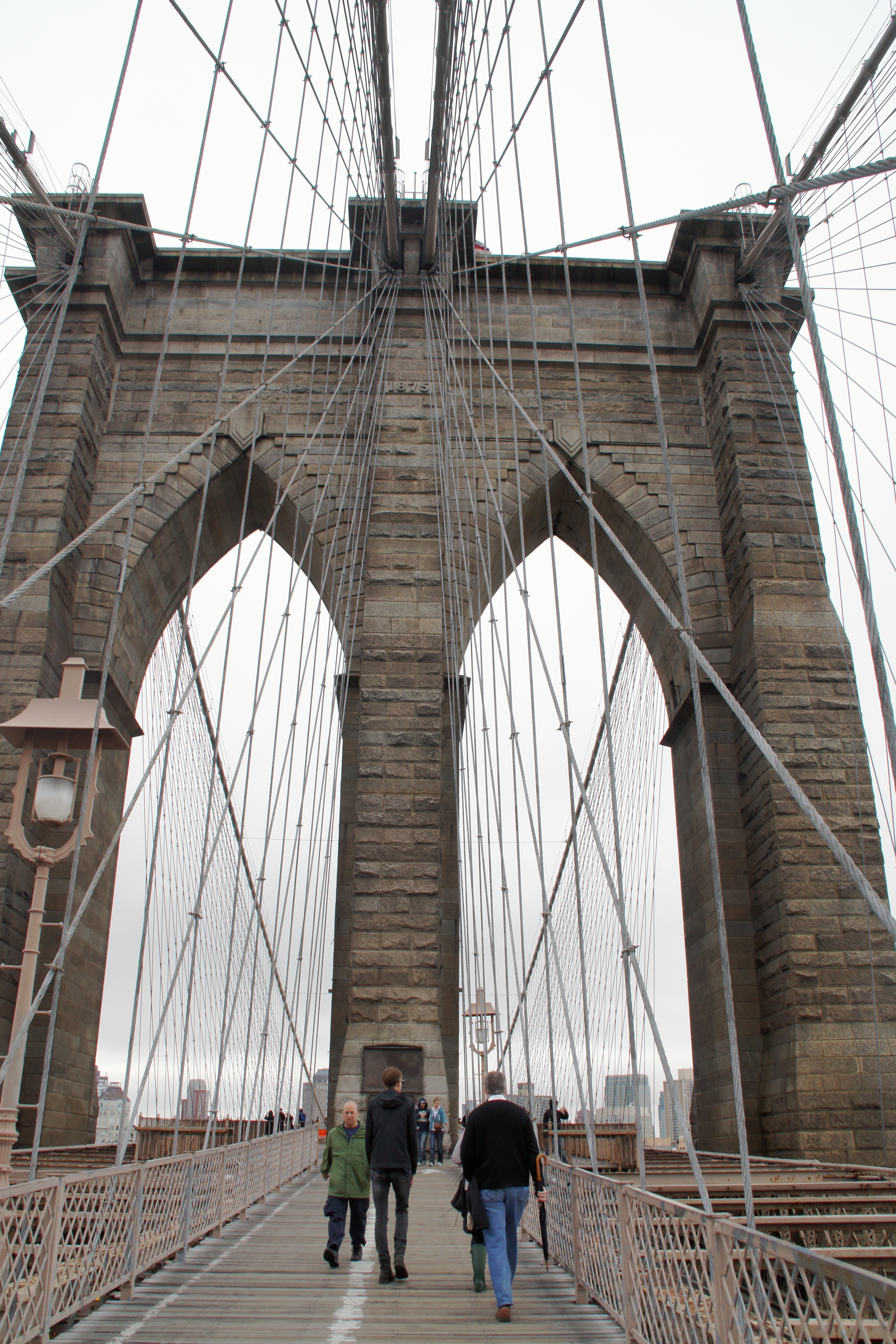
The Brooklyn Bridge is one of the most famous landmarks in New York City and  walking its span over the East River (just over a mile) is one of my favorite things to do there. A dedicated pedestrian walkway, the Promenade, runs over the center of the bridge and below an estimated one hundred forty-four thousand vehicles cross the bridge every day, which makes it hard to imagine what it was like before the bridge connected the two cities of New York and Brooklyn.  How did the Brooklyn hipsters get to the other side? By boat.

Hike along the wooden Promenade… Cables composed of 3600 miles of steel wire weaving like a spider web around you, the 276½ feet foot towers rising above, the Statue of Liberty standing guard over the harbor to one side, and the view of the city’s massive skyscrapers all around combine for an experience that makes you feel humming with energy.

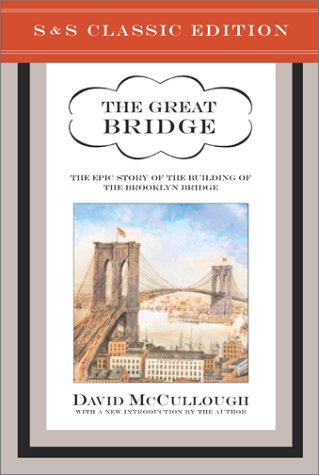
Reading David McCullough’s book The Great Bridge – The Epic Story of the Building of the Brooklyn Bridge, adds an extra dimension to a walk across the bridge. McCullough tells the story of the fourteen-year effort of building the bridge, which finally opened in 1883. It was at the time an unimaginably daring feat of engineering, exemplary of America’s Age of Optimism. As someone who lives not too far from the I-35W bridge that collapsed in Minneapolis four years ago, the enduring solidity of the Brooklyn Bridge seems even more impressive.

I was particularly fascinated by McCullough’s description of how caissons (used to plant the footings of the huge towers) work.  But, The Great Bridge is more than an explanation of civil engineering. McCullough also weaves in the politics and personalities of New York’s movers and shakers at the end of the Gilded Age, particularly the remarkable designers of the bridge, John Roebling and his son Washington Roebling, who was tragically debilitated by “the bends,” known as caisson’s disease, during the building of the bridge. For a nice discussion of the book, see the Past as Prologue blog.

Bridge-walkers disagree about which is the best way to go, Manhattan to Brooklyn or vice

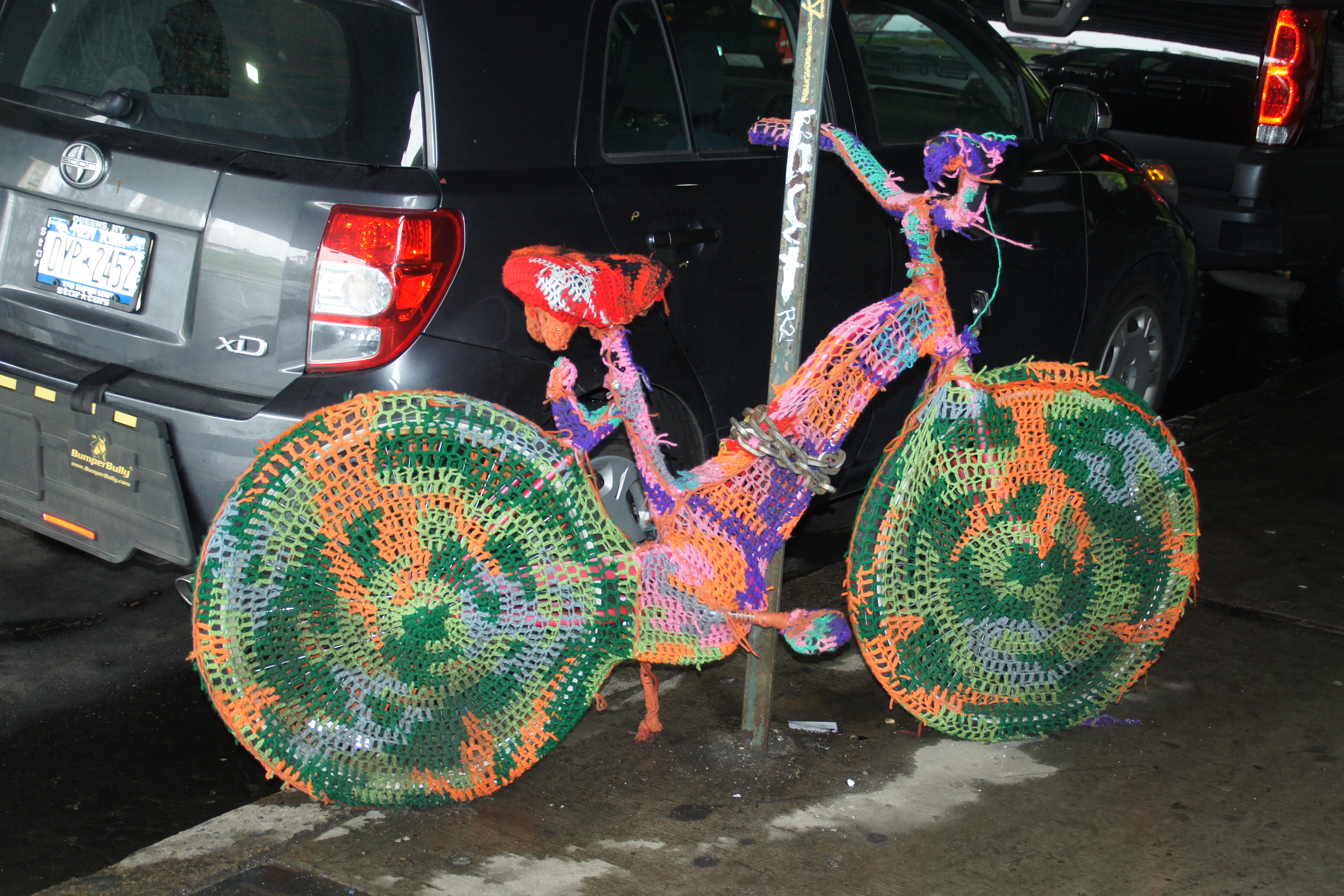
Street art in DUMBO

versa.  Some recommend taking the subway to Brooklyn and walking back to Manhattan, which offers fantastic views of the Manhattan skyline.  However, I enjoy going the Manhattan-to-Brooklyn route, with the incentive of all the great food that awaits near the end of the bridge on the other side. So, find the pedestrian walkway near City Hall in Manhattan and stroll across the bridge to the DUMBO neighborhood. That’s an acronym for “Down Under the Manhattan Bridge Overpass” but DUMBO is also under the Brooklyn Bridge.

From the end of the bridge it’s a short walk to Grimaldi’s Pizzeria, under the Brooklyn Bridge at 19 Old Fulton Street.  There’s almost always a wait, but it’s worth it.   Then, it’s time for more carb-loading, which you can justify with all that exercise you’ve done walking across the bridge. Almondine Bakery, 85 Water Street, which New York magazine calls the best bakery in the city, is a great place to stop in for coffee and pastry.  It’s especially cozy when the weather’s bad.  Or, pick up amazing chocolate-packed cookies, or homemade ice cream sandwiches at Jacques Torres  at 66 Water Street and head over to Brooklyn Bridge Park.  The Cove section of the park lies between the Brooklyn and Manhattan bridge and offers an terrific Manhattan view.  It’s also one of the few places on the New York City waterfront where visitors can actually get down to the water. Its a rich habitat for fish, crabs, and birds of the New York Harbor Estuary.

New York, bridges and chocolate…what could be better?

The Mayan Calendar, 2012

The end of the world, apocalypse, Armagedon… It seems like someone is always predicting global doom. Remember Y2K, or the famous doomsday prophet Nostrodamus?  This fascinates me because there are so many people at the other end of the spectrum looking for ways to extend their lives (or at least look really young into old age), cheat death, or freeze their dead bodies for a return to life at a later date.

The end of the Mayan calendar in December, 2012, is the latest catalyst for apocalyptic forecasting, the idea being that then end of the “long form calendar” of the ancient Mayans predicts the end of the world.  A few of you may have seen the shlocktastic movie, 2012, which is based on the concept and which one reviewer described as “cinematic waterboarding.”

On a recent trip to Guatemala, a country that is home to the world’s largest concentration of Mayan people (more than four million Guatemalans speak a Maya language), I asked a few real Mayans what they thought of the idea. Their responses ranged from bemused to philosophical. Some spoke of a “new age” of greater care for the planet, others said the changes have already happened with environmental degradation and also with our ever-connected world of communications. None thought the planet would implode next year. My general impression is that the Mayans of Guatemala have more immediate concerns like making a living, educating their children, and continuing to recover from a civil war that was truly apocalyptic for Guatemala’s indigenous people.

Robert Sitler’s The Living Maya, Ancient Wisdom in the Era of 2012, provides one of the best explanations of the whole topic.  One of the points he makes is that the Maya aren’t an extinct culture found only in the ancient heiroglyphics and ruins of ancient cities that range through Guatemala, Belize and Mexico.  Instead, Sitler, who is a professor professor at Stetson University in DeLand, Florida and serves as Director of its Latin American Studies Program, looks at the culture and traditions of real, live Mayan people.  I’d put this book at the top of reading list for anyone traveling to Mexico and Central America. And, for anyone really worried about what will happen in 2012, the folks at NASA offer a down-to-earth look at the 2012 topic from an out-of-this-world perspective.

Miguel Asturias Academy: Growing a Crop of Educated and Socially Concerned Citizens

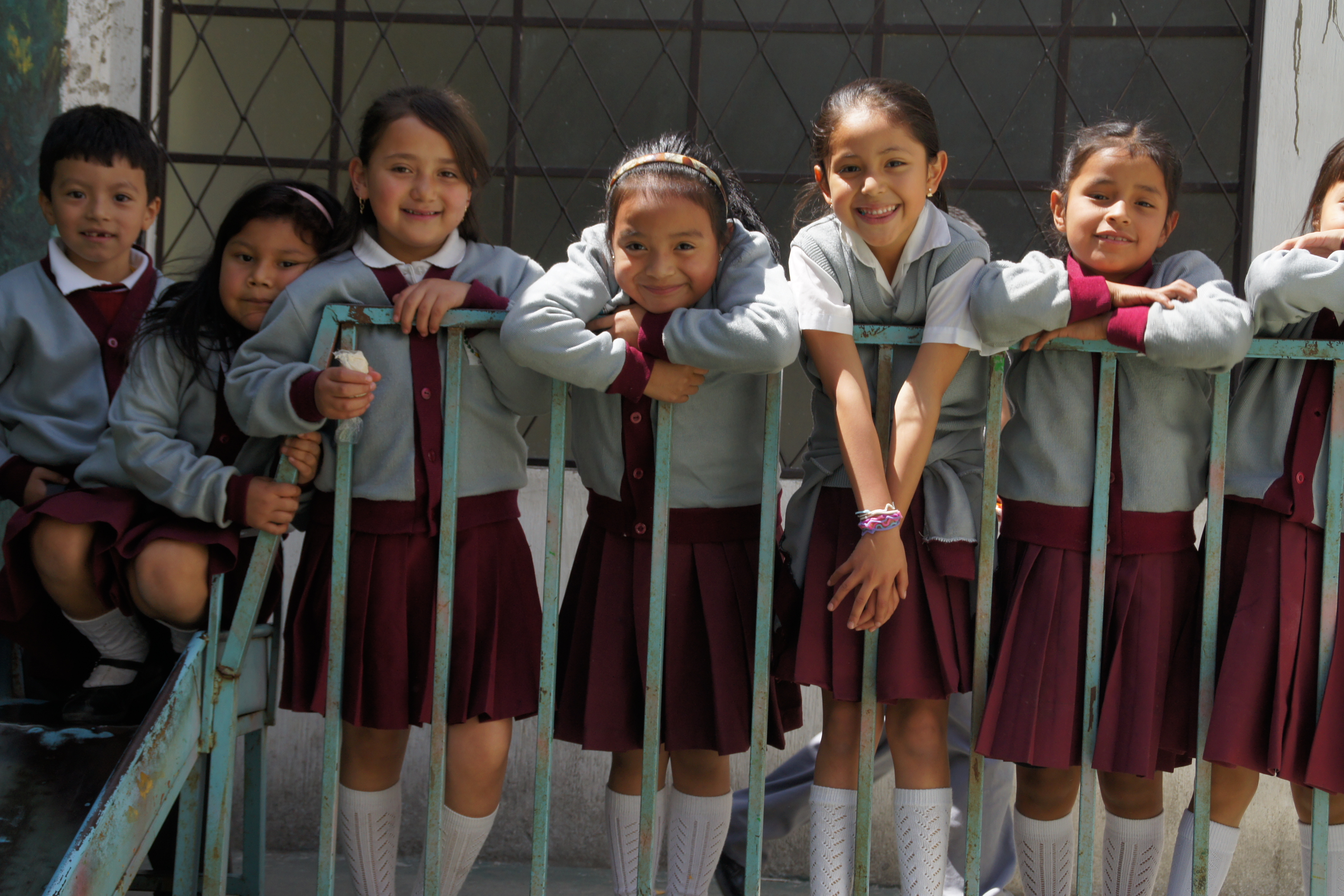
On our recent trip to Guatemala, we visited Miguel Asturias Academy in Quetzaltenango. A chance to go behind the scenes at a school is a great way to learn about local culture, what people are teaching their children, what they aspire to, and how kids there interact with each other and with their teachers.  I find this school, named after Guatemala’s Nobel laureate, particularly exciting because its leaders seek to improve life for Guatemalan children, not just through literacy, but also by teaching them about leadership, gender equity, and concern for the environment—concepts that aren’t in the typical curriculum in Guatemala, or sometimes even in the U.S.  Growing a crop of well educated, critically thinking, socially conscious citizens is about the only way I can think of for Guatemala to move beyond the conflict and corruption that has dominated civic life.

This isn’t a fancy private school for elite children. Asturias students are from a range of backgrounds from poor and indigenous to middle class. It was founded by Jorge Chojolan, who was, himself, a poor indigenous kid. Click here to see a video about Jorge and the school’s philosophy.

One of the latest accomplishments at Asturias is the new library, which still has many needs, particularly good science books in Spanish.  Librarians Without Borders (I’ve heard of doctors, but never librarians without borders) has helped them create the library, which will eventually be open to the community.  Public libraries—another of the things we take for granted.

Volcano Follies in Guatemala

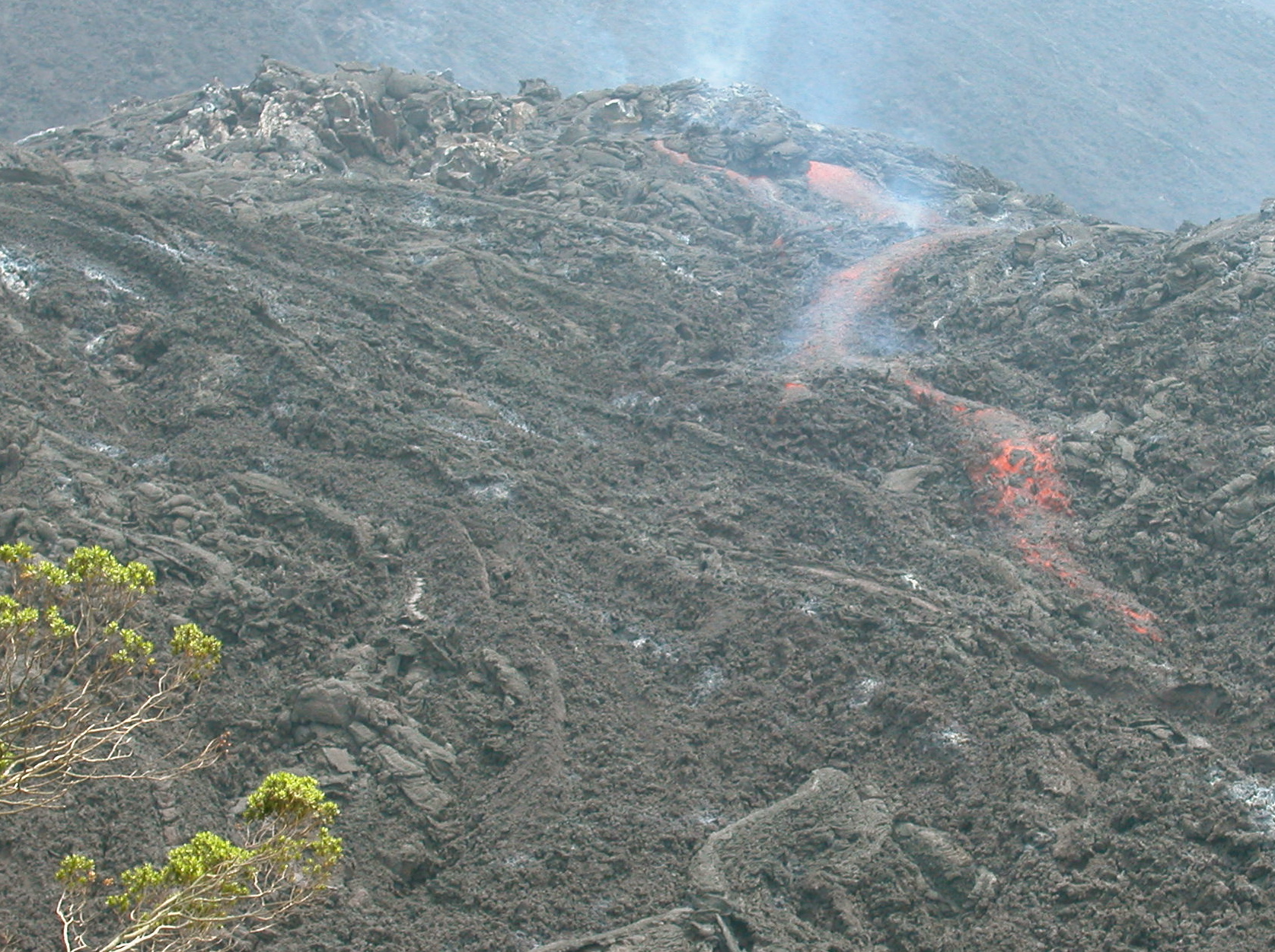
Shoe-meltingly hot lava on Volcan Pacaya

One of the most popular activities for visitors to the Guatemalan highlands is hiking up volcanoes.  Some people approach it like collecting merit badges, listing which ones they’ve “done.” That’s a big job because there are 33 volcanoes in Guatemala, three of them very active.

On our last visit to Guatemala, we hiked up Pacaya near Antigua, which is active, to say the least. It always strikes me when I visit developing countries how few safety rules there are.  For example, on Pacaya, there’s nothing stopping you from walking right up to the lava flow, except common sense, which from my own experience, (and judging from the video below) is often in short supply. Standing all too close to the lava flow—which felt like standing in front of a giant hair dryer—our guide suggested that we poke around with our walking sticks (rented from a group of local children who I initially feared wanted to swat us with them) to be sure that the scree underfoot was sturdy enough to stand on.  Oh, and be sure to check the bottoms of your shoes to be sure they’re not melting…  This just would not be allowed in the U.S. where we worry about keeping five- year-olds in car seats and constantly douse ourselves in Purell.

I recently scored my second Guatemalan volcano: Santiaguito, near Quetzaltenango.  Santiaguito is actually a junior version or extension of the much higher Santa Maria volcano, and therefore a shorter trek, which was fine with me.  The big attraction is that it erupts in a giant cloud of ash and steam about as regularly as Old Faithful geyser in Yellowstone. We started our trek around 6:30 a.m. in order to be in place to see it erupt around 8:30.  “Poco e poco,” and with several banana bread and water stops, we made it to the designated viewing spot, a kilometer or so from the crater, along with a fellow hiker from Hungary and a group from France.  Who knew scampering up a dusty trail in Guatemala could be such a cosmopolitan experience?

As can happen with travel, all did not go according to schedule.  Santiaguito was a little slow that morning.  We ate sandwiches in the company of a particularly persistent little begging dog and waited. The clouds rolled in, then the eruption began, half obscured, but viewable nonetheless.  The sound, even at that distance, was amazing, like a huge roaring jet engine.  Of course, if we had been closer, the clouds wouldn’t have been such a problem but I’ll trade a better view for a modicum of safety.  Here’s a video from a guy who was a little too close to Santiaguito for comfort. 

Poco a Poco: Biking to San Andres Xecul, Guatemala

Xela, Guatemala (a.k.a., Quetzaltenango) lies at 8,000 feet in the heart of the country’s

Biking through the farmland near Xela.

highlands and at the center of its Mayan population. Xela (pronounced shay-lah) is a great base from which to explore a huge array of nearby sites and activities. However, at

that altitude, I’m wary of doing anything that requires more exertion than sampling some of the country’s great coffee in a café or watching others exert themselves in a game of fútbol. Still, the possibility of a trip to a rural village that boasts the most colorful church in all of Central America prompted me to get trade my café chair for a bike to ride to San Andrés Xecul.

Traditional Mayan worship meets Catholicism at San Andres Xecul in Guatemala

Fortunately, there were only a few steep patches, and the friendly people in the village (one little boy kept pointing at us and saying “Gringos, Mama!”), a nice sugary Roja from a local tienda, and the Technicolor church made it worth the occasional gasp for oxygen.  Our guide from Altiplano Tours  was merciful: “Poco a poco. It’s not a race.”  Poco a poco, little by little, became the mantra of our trip and as I think about it, that’s a pretty useful phrase for most of life.

Cuanto Cuesta? Getting Psyched to Bargain in Guatemala

Embroidery for sale in Chichicastenango, Guatemala. Who can resist?

In anticipation of traveling to Guatemala, I’m trying to get myself into bargaining mode. I have to do this because I am the world’s worst haggler.  Offer me something for $5, I’ll pay $8 for it. Put a cute kid in front of me and it’s all over. This drives my spouse, the world’s best and most unemotional bargainer, completely nuts.  It doesn’t matter how inexpensive the item the child is selling, he asks for a lower price.

I, on the other hand, offer an amount which is the selling price plus my “empathy quotient,” based on how much I envision the money meaning to the child’s family and how much I would hate having to go out and haggle with tourists if I were that kid.  Then I add more money simply because I’m a wimp.  Any ten-year-old Guatemalan kid holds great power over me. Then the word spreads that he has a “fish on the line.”  His friends show up. They laugh. They give each other high-fives. It doesn’t matter, I can’t say no. Last time I was there, a little girl asked me to buy some dolls.  I said I didn’t need them.  She said, “Buy them for your friends.”  I told her I didn’t have any friends.  She said, “For your enemies.” I told her I’d take two because she was funny.

So, if you see someone walking around Minnesota in winter wearing an embroidered blouse, sandals and carrying dolls, you’ll know it’s me.

McSorley's Old Ale House-Glad to see this NYC institution still going

I was happy to read in the New York Times that McSorely’s Old Ale House is going, even if its without the old chicken bones. Writers (Ginsberg, Kerouac, Menken, the McCourt brothers), artists, and politicians have whet their whistles here since forever.  e.e. cummings wrote a poem about the place

I was sitting in mcsorely’s. outside it was New York and beautifully snowing. inside snug and evil…

Some things just should not change.