Tag Archives: reading

Eat, Read, Cheer: Ann Arbor, Michigan

University of Michigan Stadium, "the Big House" in Ann Arbor
University of Michigan Stadium, “the Big House,” in Ann Arbor

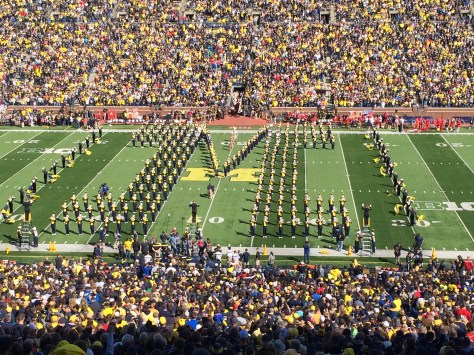
Whether you’re a died-in-the-wool Wolverine or not, fall is a fantastic time to visit Ann Arbor, Michigan.  Even without football tickets, you can tour the “Big House,” the University of Michigan’s football stadium which is the largest stadium in the United States, the third largest stadium in the world and the 36th largest sports venue. Its official capacity is 109,901, but it seems like whenever I’m there they have at least 110,000.  No matter how well the team plays, there’s nothing like walking into this stadium on game day and I always enjoy walking to the stadium behind the marching band.

The University of Michigan Marching Band.
The University of Michigan Marching Band

As long as you’re on the campus of my alma mater, be sure to stroll

University of Michigan Law School's beloved Reading Room
University of Michigan Law School’s beloved Reading Room

the “Diag,” the heart of the central campus for some great people watching, pop into the law school’s Hogwarts-like reading room, and spend some time in the terrific art museum on campus. The  museum’s new modern wing, with its Tisch Gallery of Modern and Contemporary Art, offers a look at some very important works by Picasso, Marcel Duchamp, Alberto Giacometti and Max Beckman, to name a few.

Hungry?  Head to an Ann Arbor classic,  Angelo’s, for a breakfast that will fill you up for the rest of the day.  Calorie counts don’t usually slow me down, so despite my gigantic breakfast, I like to stop by Dominick’s for beer, sangria, pizza or subs.  Need something to wash all the down?  I’ve always been partial to the milkshakes at Pizza Bob’s.  Finally, you’ll want to round out your Ann Arbor pig-out weekend with a stop at  Zingerman’s Deli or Zingerman’s Roadhouse, or both.

Wait!  Don’t pick up another pastrami sandwich or you’ll burst.  feast of loveInstead, pick up a feast that will be easier on your arteries, Charles Baxter’s novel, The Feast of Love.  It’s set set in Ann Arbor where Baxter was an English professor (he’s now at the University of Minnesota).  This terrific book as nominated for the National Book Award.

Be a Rebel – Read Banned Books (They’re More Interesting)

I used to love to sneak into the adult section of the library when I

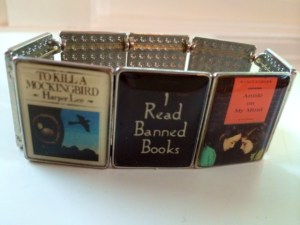
My Banned Books bracelet.

was in grade school.  I lived in a small Michigan town with a very loving yet stern librarian who I remember vividly, Miss Lillian Crawford.  She knew my my grandparents, my parents, and probably most of the parents of children who came to the library.  My mom dropped me off on Saturdays while she got her hair done, making the library both a source of child care and intellectual stimulation.

Occasionally I drifted from the sections that Miss Crawford deemed appropriate for my young mind into the adult fiction. Ohh, la, la–swearing, sex, and ideas I didn’t understand. Actually, I probably didn’t understand the sex, either. Miss Crawford ratted me out to my mother.  I was a super good girl and Mom, fortunately, thought it was amusing that I went astray in such a way. What  a rebel!

Forgive me, Miss Crawford

During this week’s discussion and celebration of banned books, I have to say both Mrs. Crawford and my mom were right.  There’s nothing wrong with guiding young people in their reading, getting them to read in the first place, and encouraging age-appropriate, quality literature. So, I have some sympathy for parents who worry about the books their children are exposed to in school. But, though it was probably benign neglect rather than liberal thinking, I’d err on my mother’s more permissive side every time. What is reading about if not about challenging old ideas, learning about other people, the wider world, and about ourselves?

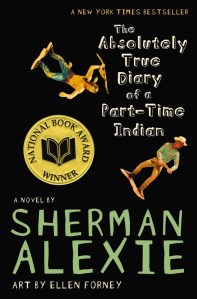
One the the most frequently banned authors currently is Sherman 28c4d1f2e8d048f702c3dbf0990aca8cAlexie.  He grew up on the Spokane Indian Reservation in Wellpinit, Washington.  His stories about life on the reservation are often far from the mainstream portrayal of Native Americans and consequently his book The Absolutely True Diary of a Part-Time Indian is regularly at the top of the most challenged list.  He says on his website, “It means I’m scaring the right people.  Hooray! I keep hoping somebody will organize a national boycott against me.”

Banning books is all about fear.  Fear of ideas that challenge our religious and world view.  Fear of children learning about sex and fear of people whose skin color is different.  In an article on Huffington Post, Bonnie Stiles, mother of four students in Meridian, Idaho schools where Alexie’s book was recently banned, said she pushed for its removal from the high school curriculum after reading the book and counting 133 profane or offensive words in its 230 pages. Really, if that’s your worry, you need to ban your children from riding the school bus where that language is freely shared.

Forgive me Mrs. Crawford! But, friends, I encourage you to be a rebel and let your freak flag fly.  Read those banned books yourself and, rather than counting swear words, discuss the books with your children. Encourage your book club to join you in reading banned books.  Take a look at the ideas and recommendations some of my favorite books bloggers are offering this week: Sheila at Book Journey, Epic Reads, and Banned Books Club.  You’ll also find lists of current and classic banned books  and this list of banned classics from the American Library Association’s Office for Intellectual Freedom.

Finally, for inspiration, listen to what Bill Moyers said a couple of years ago.


Raymond Chandler and a Noir View of Santa Monica

There was a desert wind blowing that night. It was one of those hot dry Santa Anas that come down through the mountain passes and curl your hair and make your nerves jump and your skin itch.  On nights like that every booze party ends in a fight.  Meek little wives feel the edge of the carving knife and study their husbands’ necks.–Raymond Chandler, “Red Wind”

Unknown-3
Raymond Chandler

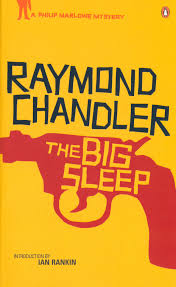
I’ve never been a huge fan of crime fiction, but I’ve found I can’t resist Raymond Chandler, the king of the detective novel, because he can turn a phrase like no one else.  Sit down with one of his classics–Farewell, My Lovely or The Long Goodbye, for example–and you’ll soon find yourself on the hunt for “Chandlerisms” like “as conspicuous as a tarantula on a slice of angel food.” His dialogue and similes are so crazy and over the top I want to memorize them and use them in my own conversation.

imagesBeyond the similes, you start to recognize in Chandler’s work all of the hallmarks of “hard-boiled” and “noir” detective fiction–the shadowy scenery, the sleazy criminals, and Phillip Marlowe, the epitome of the tough and surprisingly idealistic private eye. The dialogue, the setting, and the characters are all as familiar as the nose on a washed-up boxer’s ugly mug, but it was Chandler who created them and, in the process (along with fellow crime writers Dashiell Hammett  and James M. Cain), pioneered a uniquely American literary genre and style.

Bogie and Bacall brought his hard-boiled characters to life on the big screen and his stories have been the subject of parody by everyone from Woody Allen to Steve Martin to Garrison Keillor.  As Paul Auster, a modern crime writer, says, “Raymond Chandler invited a new way of talking about America, and America has never looked the same to us since.”

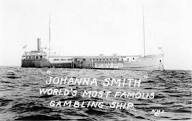
In Raymond Chandler's day, an infamous fleet of gambling ships anchored just far enough offshore to be beyond the jurisdiction of California state law.
In Raymond Chandler’s day, an infamous fleet of gambling ships anchored just far enough offshore to be beyond the jurisdiction of California state law.

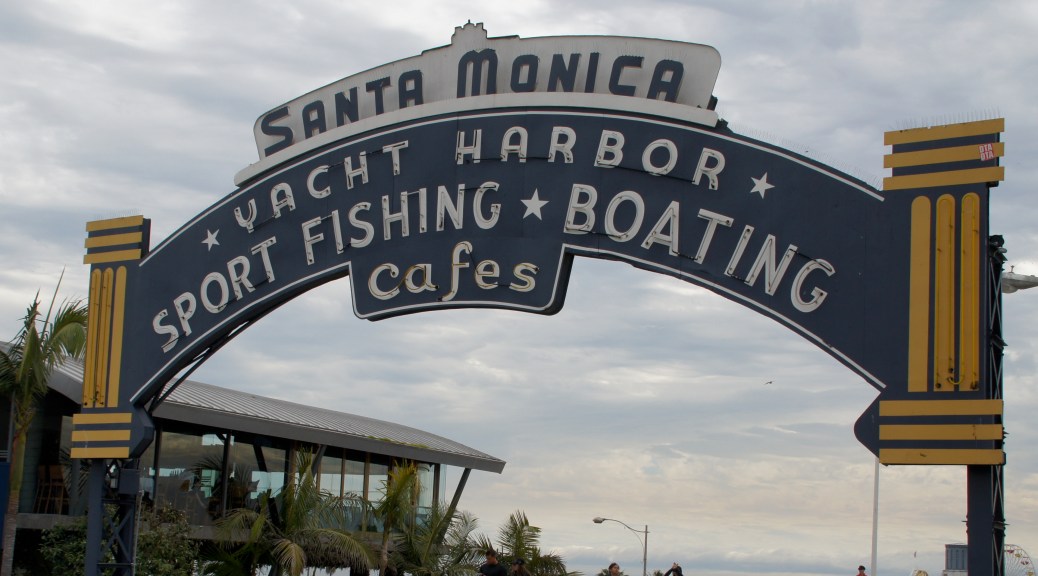
The Los Angeles area of the 1930s and 1940s was rife with organized crime, greed, and celebrity scandals.  In particular, daily life in Santa Monica, the beachfront town on the western edge of Los Angeles where Chandler lived for a time and which appears as Bay City in his books, offered plenty of material from which to draw his stories.

If you visit Santa Monica and the Los Angeles area, it’s fun to read Chandler’s books and those of his crime fiction contemporaries and picture the area as it was then.  He described it as a place with “lots of churches and almost as many bars.”  It’ll add a little depth to your understanding of the area, beyond Hollywood and UCLA/USC football.  Esotouric offers literary tours of Los Angeles including one focused on Raymond Chandler and another on James M. Cain. You might also enjoy their podcasts.  In addition, the Santa Monica Conservancy offers walking tours that cover Santa Monica history.

Santa Monica’s “mean streets” have been replaced by glamorous shopping streets such as Montana Avenue and the Third Street Promenade.  Yet, enough of the old Bay City remains today to get your imagination moving, including the famous Santa Monica Pier and Main Street’s deco-era City Hall, the scene of many of Phillip Marlowe’s coming and goings. Of course, there’s still the harbor and “beyond it the huge emptiness of the Pacific, purple-gray, that trudges into shore like a scrubwomen going home.”


The House of Seven Gables and Other Things to Do in Salem, MA


The mysterious House of Seven Gables in Salem, Massachusetts

Salem, Massachusetts, makes a nice day trip from Boston and if you’re there, a stop at the House of Seven Gables is a natural for lit 9780451527912_p0_v1_s260x420lovers or anyone who likes the occasional glimpse of really old colonial homes.  Author Nathaniel Hawthorne’s cousin, Susanna Ingersoll (and other ancestors who played a part in the Salem Witch Trials of 1692), lived in the house and he visited there frequently. He stated that his book, The House of Seven Gables, was a complete work of fiction, based on no particular house.  Nonetheless, as you tour the tiny, dark rooms typical of the era in which it was built (the late 1600s), it’s easy to see how such a house could set the author’s imagination rolling.  The site also offers a chance to tour the house in which Hawthorne was born (which was moved to this site) along with several other buildings of that period.

If you haven’t read The House of Seven Gables, the novel follows a New England family and explores themes of guilt, retribution, and atonement, with overtones of the supernatural and witchcraft.  For me, the book doesn’t compare to Hawthorne’s classic, The Scarlet Letter.  However, it was an inspiration for the horror fiction writer H.P. Lovecraft who called it “New England’s greatest contribution to weird literature.” That seems a backhanded complement to me.

You can tour this tall ship at the Salem National Maritime Historic Site.
You can tour this tall ship at the Salem Maritime National Historic Site.

While you’re in Salem, I also recommend stopping at the Salem Maritime National Historic Site, a short walk from the House of Seven Gables. The National Park Service operates it and you can wander through old wharf buildings, the Custom House where Hawthorne worked when he wasn’t penning famous novels, and other buildings of the colonial era.

Salem was, of course, the home of the famous Salem Witch Trials Unknown-3which were the focus of Arthur Miller’s classic play, The Crucible.  The National Park Service Visitor Center (2 Liberty Street) is a great place to get quality background on that incident.  It’s ironic that Salem has made a cottage industry out of the witch trials when our puritan ancestors were so thoroughly opposed to witches. Unless you’re a fan of super-tacky witch paraphernalia and occult museums, stick with the Park Service displays on the subject and skip the other witchy tourist traps.

Books Make a Difference Features Off The Beaten Page

Christened "the bookmobile" our RV was ready for a book club trip to Wisconsin.
Christened “the bookmobile” our RV was ready for a book club trip to Wisconsin.

Many thanks to Meagan Frank for her terrific article in the onlinemagazine Books Make a Difference. It’s about my book, Off The Beaten Page: The Best Trips for Lit Lovers, Book Clubs, and Girls on Getaways and how travels with my book club (check out the photos of our RV trip) inspired me to write the book. Check it out:  Book Lover Getaways.

The article offers inspiration for anyone in a book club who has been thinking of organizing a book-inspired getaway.  You’ll want to read other articles there, too, about the “positive difference books make in people’s lives.”  So true.

Eating and Wearing Stinky Cheese in France

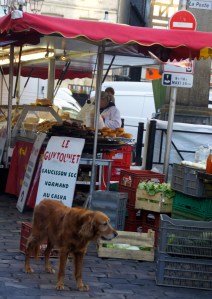
At the outdoor market in Honfleur, where I purchased the Livarot cheese. Its scent perfumed me and my car for the rest of the day.

Livarot is one of the oldest types of cheese in France and it smells like it—like its been hanging around gaining strength since the 1600s. A specialty of the Normandy region, Livarot is a soft “washed rind” cheese which means it is typically bathed in a wash of salted water which helps break down the curd from the outside, influencing the texture, aroma and flavor of the entire cheese. The “bath” does absolutely nothing to cure the smell.

It may be an urban legend, but I’ve since read that Livarot is banned on public transportation in France. Its earthy aroma  has been described by some as reminiscent of feces or “barnyard.”  I would never have ordered something with that description, but it first came to me on a cheese plate in a restaurant in Honfleur, in Normandy, a small slice, apparently exposed to the air long enough to diminish its signature odor. And it was great.

Good enough to make me want to purchase some at the market the next morning, in the process of packing up a few goodies for our lunch that day— a little french bread, sausage and a bit of the cider for which the region is also famous, and which smells much better than the cheese.

SONY DSC SONY DSC

Melons at the market

I packed our picnic into my backpack, which stayed locked in our small closed car until lunch time, imparting a zesty Livarot odor to our car, a smell somewhere between stinky feet and a gym bag full of recently used hockey gear.

We were able to eat our picnic in the open air and again the taste of the Livarot seemed wonderfully unrelated to the smell. We couldn’t eat all the cheese, so frugal as I am, I wrapped up the leftover cheese and returned it to my backpack for later consumption.


In his wonderful book French Lessons: Adventures in Knife, Fork and Unknown-3Corkscrew, Peter Mayle devotes a whole chapter to the Livarot cheese fair in the town of Livarot, and in particular, the cheese eating competition. The rules: a time limit of 15 minutes during which contestants must eat their way through two whole cheeses, each weighing about two pounds. “Livarot,” he says, “is not a modest cheese. It announces itself to the nose long before it is anywhere near you mouth, with a piercing, almost astringent aroma.”

That may have been the reason why that evening when we checked into our hotel, I noticed that the hotel clerk and other people in the lobby appeared to move away from me or avert their faces. “Madam!”  I realized that I was wearing the Livarot-filled backpack and exuding that aroma wherever I went. Formidable!

Have you ever had a food-related travel incident?  Please tell us.

Great Books for Children on Earth Day

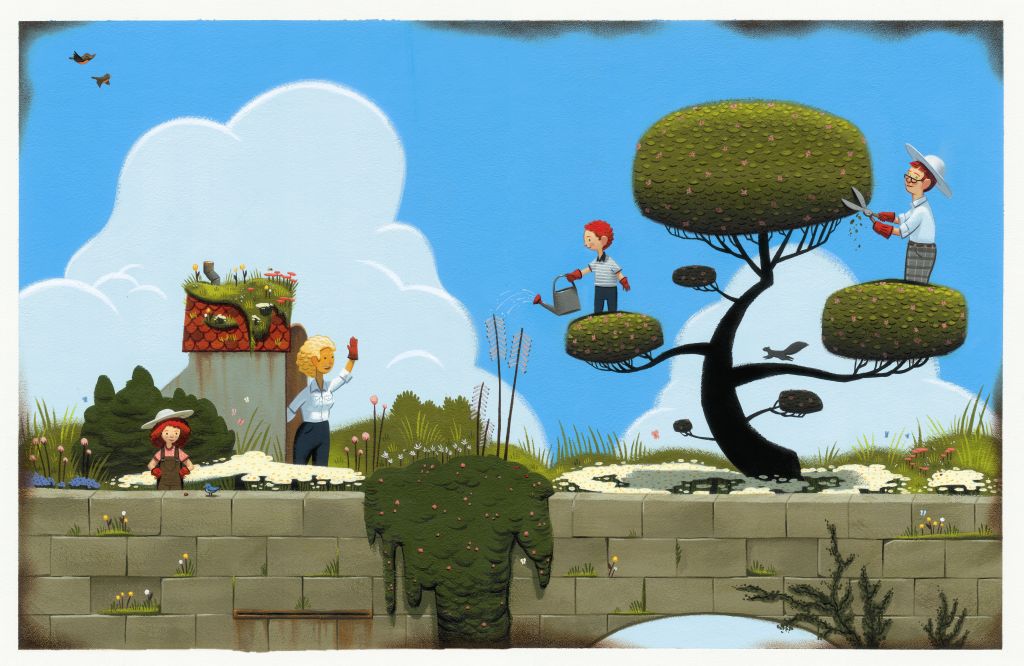
An illustration fron Peter Brown's beautiful children's book "The Curious Garden."
An illustration fron Peter Brown’s beautiful children’s book “The Curious Garden.”

If you’ve spent any time reading this blog, you know my goal is to encourage people to READ and GO. Literary travel means reading a great book and going where it takes place or to the type of place the book is set, which can be right in your own town. Literary travel allows you to experience both the book and the place in a more intimate way. And, it’s a great way to expose children to the pleasures of reading, giving them more ways to relate to books and their subjects.

Take, for example, the topic of Earth Day. What better way to help kids understand the

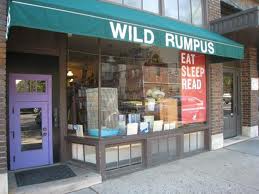
Wild Rumpus Book Store in Minneapolis
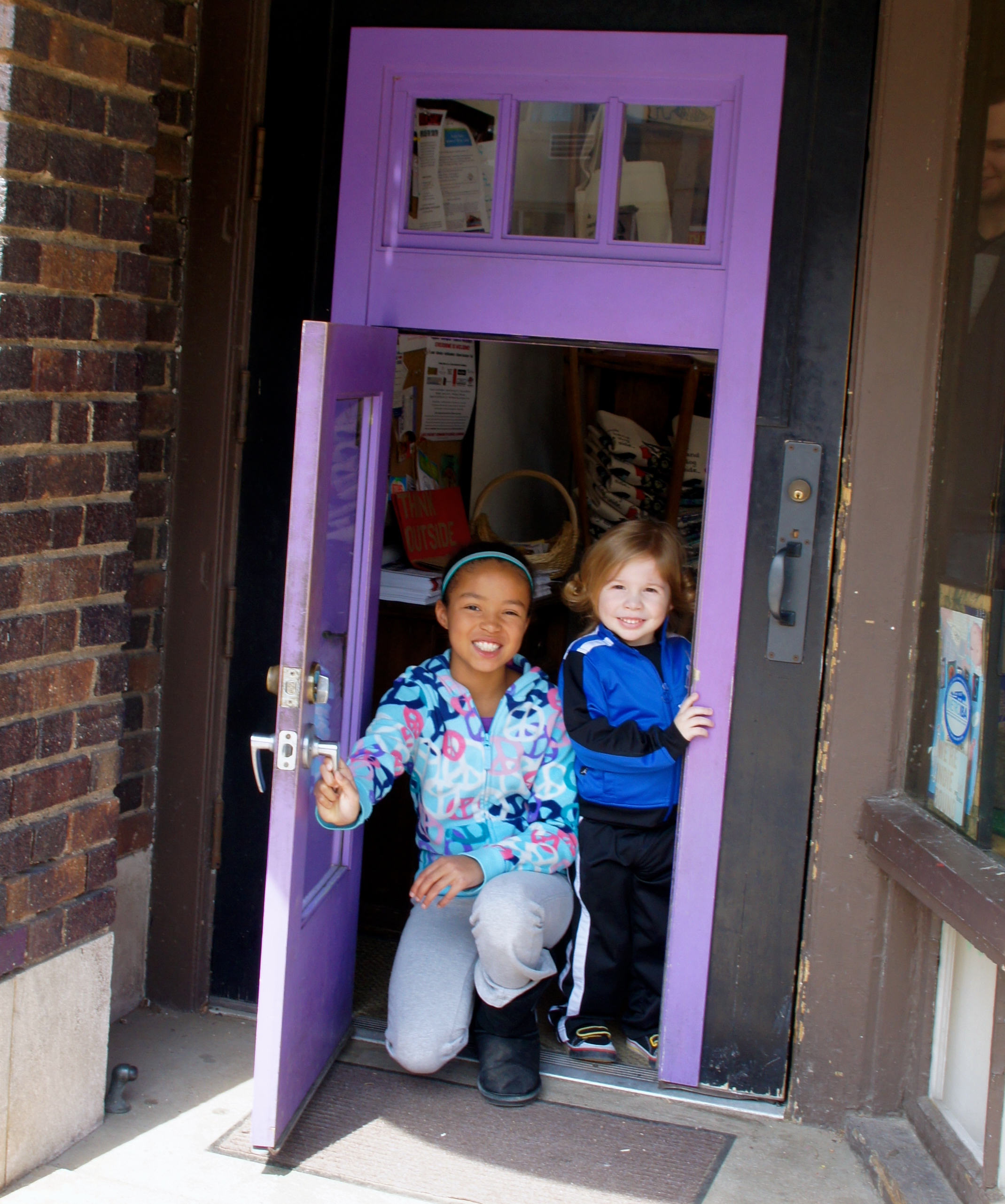
Exiting Wild Rumpus through the child-size purple door.

concept of caring for the environment than by reading a super-engaging book on the topic and then venturing out on a lit trip to a local park, garden, or community Earth Day event? Listen up grandparents, aunts and uncles and others who seek interesting ways to interact with the children in your life. You should put Last Child in the Woods: Saving Our Children From Nature-Deficit Disorder on your list.

For a few great book suggestions, I stopped by one of the country’s all-time best children’s bookstores, Wild Rumpus in Minneapolis. I have to admit that since my children are grown, I look for just about any excuse to wander into this store, which is full of fun booksellers, live animals, special events, and cozy reading spots, not to mention books, books, books. It’s pretty entertaining just watching children and their families interact with everything in the store. Don’t have kids? Wild Rumpus has a great selection of YA and adult books, and you can still enjoy the animals.

Here are a few of their Earth Day reading suggestions:

 The Curious Garden by Peter Brown

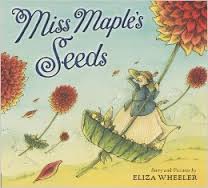
Unknown-10Miss Maples’ Seeds by Eliza Wheeler

Unknown-3Celebritrees— Historic and Famous Trees of the World by Margi Preus

Unknown-2


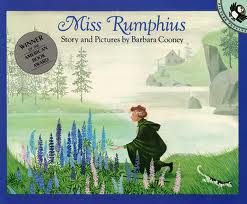
Miss Rumphius by Barbara Cooney


A Short Visit at O. Henry’s Tiny House in Austin, Texas

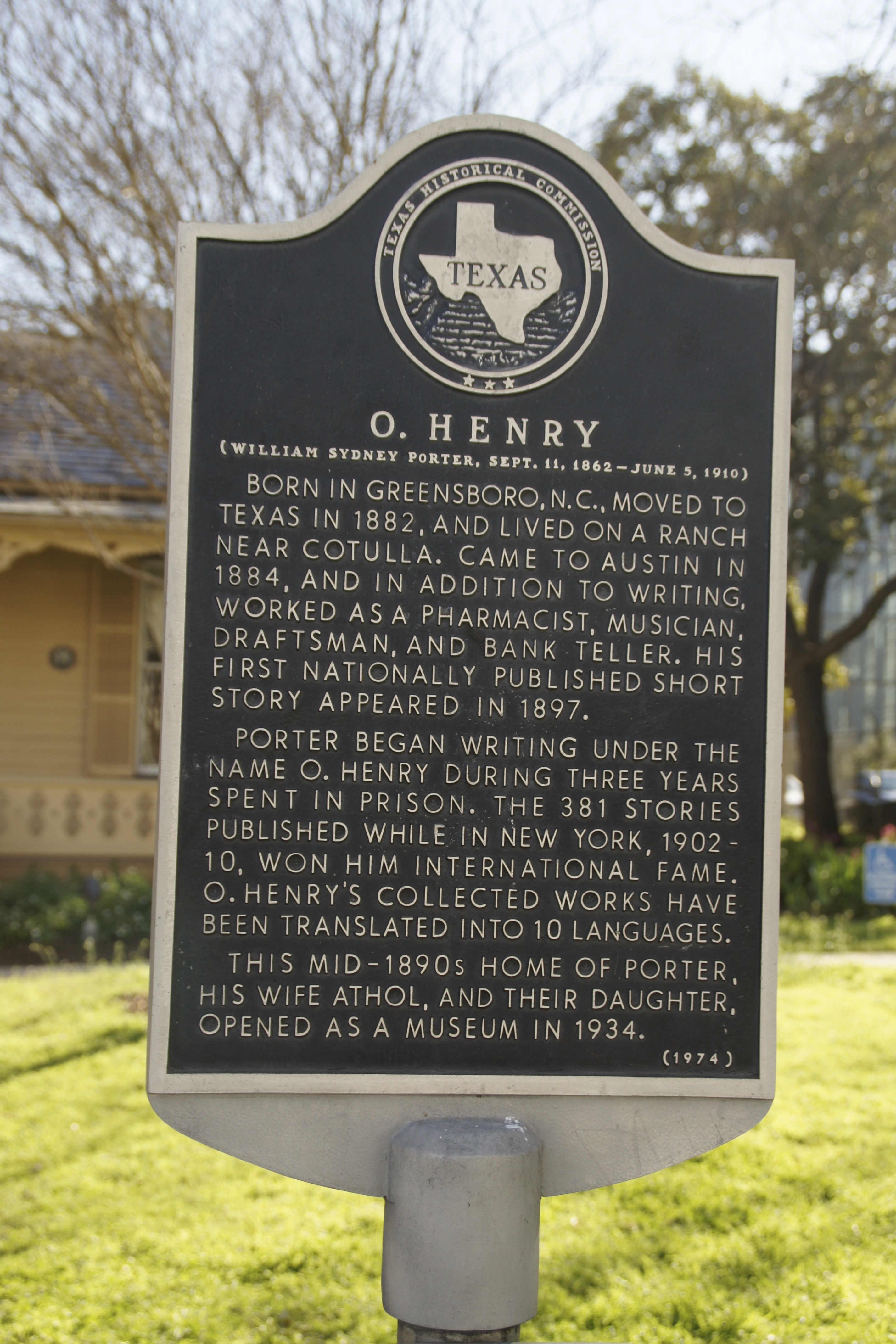
Before William Sydney Porter, aka O. Henry wrote his famous short story “The Gift of the Magi,” he lived for a few years in Austin, Texas. The tiny house he rented survives as a museum. It’s tucked in right next to the giant Hilton Austin in the center of town and this property looks like it would have great potential to become a parking lot or fast food joint, and in fact it barely missed the wrecking ball back in the 1930s.

As I’ve mentioned in a previous post on authors’ homes, the places where famous authors SONY DSClived are often a disappointment compared to the places they describe in their books.  And,  a huge modern building right next door doesn’t help you envision the author’s life as it was in the 1800s.  Nonetheless, if you’re in Austin, you should pay a call at Porter’s house, if only to get a taste of how people lived at the time. The price is right, too.  It’s free, but please make a donation when you leave.

While he resided here (1893 to 1895), Porter made his living drawing maps for the General Land Office and publishing a paper called the Rolling Stone (quite different from the current publication of that name).  Before you go, be sure to read a couple of his most famous stories–“The Gift of the Magi” or “The Ransom of Red Chief.”

Unknown-10
William Sydney Porter, aka O. Henry

Ah, the symbolism. If Porter could see his tiny home now, wedged in next to the giant hotel, I’m sure he would find inspiration for another story.


Move over, Jack Kerouac. Five Books by Women to Inspire Your Next Trip

The most famous travel books have been written by men: Travels with Charley, On the Road, and Blue Highways, to name a few. But women have been “on the road,” too, and not just Route 66.

I love reading books about women’s adventures. I especially like funny stories, with plenty of travel mistakes, misadventures, mix-ups. And, I appreciate most the stories that weren’t inspired by trauma, bad boyfriends, dead or abusive husbands, or the authors’ search for new love. Eat…pray…you know what I’m talking about. Instead, I go for the stories that were simply rooted in a woman’s daring and love of adventure. Here are a few favorites.

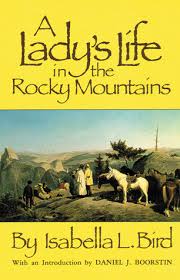
A Lady’s Life in the Rocky Mountains, Isabella BirdUnknown
The amazing Isabella Bird was an Englishwoman who lived a life of continual travel and was, as a result, the first woman to be elected the the Royal Geographic Society. She came to Colorado in 1873, three years before it became a state. She traveled solo through the wilderness and covered more than eight hundred miles during her journey around Colorado, which she described in letters that she wrote to her younger sister in Scotland. The letters were published in 1879 as A Lady’s Life in the Rocky Mountains, part travelogue, part memoir, part character study of the people who settled on the frontier, especially “Mountain Jim,” a handsome trapper and desperado with whom she was fascinated. Bird was also one of the first of a genre that we now call “environmental writers.”

By Motor to the Golden Gate, Emily PostUnknown-7
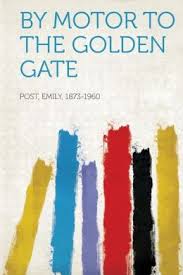
Emily Post was a travel writer. Who knew? This book is a reprint of articles originally published on Colliers Magazine seven years before she became famous for her book on etiquette. In 1915, Post documented her New York-to-San Francisco road trip investigating whether it was possible to drive comfortably across the country an automobile. That was a valid question since few women of her Gilded Age background did such daring things and because she was driving on the Lincoln Highway, this country’s first transcontinental highway. 

The Wilder Life, Wendy McClurewilderlifecover-e1287450561388
Do you travel to visit places where you can pursue hobbies or a particular interest? Wendy McClure sets the bar high for anyone who travels in pursuit of a particular passion. In her case it’s Laura Ingalls Wilder’s Little House on the Prairie books and her effort to re-create “Laura World” for herself. She investigates the settings and activities that have made several generations of young readers flock to the Little House books and to the sites across the Midwest where they took place. See my article my previous post on this book and my article, Novel Destinations, for my own encounter with Laura World.

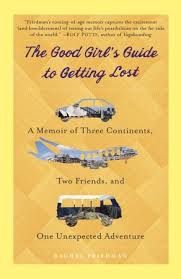
The Good Girls Guide to Getting Lost, Rachel FreidmanUnknown-8
We’ve read plenty about bad boys on the road; Jack Kerouac is the most famous.  That’s why it’s nice to learn that good girls like Rachel Friedman can take risks and open themselves to great new experiences. She goes to Ireland on a whim where she forms a friendship with a free-spirited Australian girl, a born adventurer, who spurs her on to a yearlong odyssey that takes her to Australia and South America, too, and learns to cultivate her love for adventure.

No Touch Monkey, Ayun Halliday
If you’ve ever made grievous errors in judgement while traveling, you’ll relate to Halliday’s experiences, which she doesn’t hesitate to share— from hygiene to intestinal problems to a collagen implant demonstration during Paris fashion week with her mother.Unknown-9I enjoyed her sarcastic writing style, her impressive globe-trotting, and her openness to adventures that wouldn’t even occur to me. She’s a witty observer of the details that most travelers see but forget about. For example, the title comes from a sign she saw in Bali with rules to assure “your enjoymen and safety” including: “Never grab a monkey. If a monkey gets on you, drop all your food and walk a way until it jumps off.”