If you can't make it to the National Book Festival, you can take advantage of podcasts from authors who will appear there.
September 25, 2011, on the National Mall in Washington, D.C. It’s a bit of readers’ heaven, with discussions and readings from authors including Toni Morrison, Sherman Alexie, David McCullough, Russell Banks, Edmund Morris, Michael Cunningham, Jennifer Egan… the list goes on and on.
But for those who can’t make it to the actual event, the Library of Congress, which sponsors the festival, is offering podcasts from some of the authors who are appearing at the event this year. For avid readers and for book clubs the National Book Fest site is a great way to get ideas for your next reading list. And, listening to these podcasts offers interesting insight from these authors and a way to go a bit more in depth for your next reading discussion.
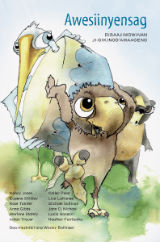
I’ve written several times in this blog about Birchbark Books, a great indie bookstore in Minneapolis—author Louise Erdrich, proprietor. Erdrich and her sister, Heid Erdrich, also founded Wiigwaas Press (part of the non-profit Birchbark House) in order to promote indigenous language revitalization through publications and programs. A book for young readers from Wiigwaas Press, Awesiinyensag: Dibaajimowinan Ji-gikinoo’amaageng, written totally in Ojibwe, has been named Minnesota’s Best Read for 2011 by the Center for the Book in the Library of Congress. It is Minnesota’s official selection to represent all of the publications in the state this year at the National Book Festival, Sept. 24-25, in Washington, D.C.
One of the book’s co-editors, Anton Treuer, a professor of Ojibwe language and culture at Bemidji State University in Minnesota, says, “I just love it that anyone who wants to read the best book in Minnesota this year has to read it in Ojibwe.” That may be difficult for most of us. Though we use many Ojibwe words such as moose and Mississippi, the language itself is at risk of disappearing. Treuer explains his interest in preserving the language in this video. Or, you can read his highly-praised books about the Ojibwe (in English), The Assassination of Hole in the Day, and the Ojibwe in Minnesota.
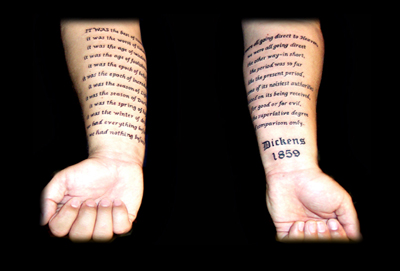
This literary tatoo is a little more extensive than I would suggest.
Literary Tatoos.” She says she has always had a fascination with tatoos, but heeded her mother’s warning not to get any, along with a whole of of other taboos. I as a mom I have issued the same warnings….”You’ll be sorry someday….” But I have to agree with her that a literary tatoo holds some merit. So much more clever than the barbed wire that basketball players have.
Rudd says,
Books that are important to me, leave an indelible mark on my thoughts, beliefs, and life. It seems to me that have a tattoo at all gives you a permanent connection to art. Having a literary tattoo gives you a permanent and explicit relationship with the words that have touched you, marked you. How can could I say no to that? So when it first occurred to me that one could get a tattoo based on a book, poem, etc., I was hooked.
If it’s a classic quote or title, it would never be passe or out of style. If short, it could be discreetly placed and not too painful. It would be flashed only in bookstores, libraries, book club meetings and other bookish locations where people could appreciate it. She suggests something related to Richard Adams’ Watership Down, a rabbit-related tat. Check out the site Contarywise to see a few photos and read the Guardian article, “Ten of the Best Tatoos in Literature.” I’m thinking the phrase “And So It Goes” from Vonnegut’s Slaughterhouse Five.
I laughed this week when I heard a story on National Public Radio about how gun
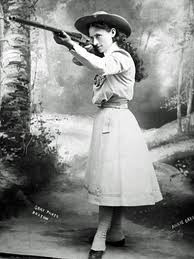
Women have been gun enthusiasts since the days of Annie Oakley, but I'm intrigued by the idea of a book club at the shooting range.
makers have “set their sights” on female buyers and that women make up a growing percentage of gun owners. One of the women they interviewed goes to the shooting range—with her book club. One wonders what they could be reading to inspire gun training… self –empowerment books? Violent books about women being attacked? Westerns?
I have to admit I’ve never shot a gun myself, but I don’t have any objection to gun training and I would go to a gun range if someone really wanted me to go with them, just for the experience of it. Moreover, I don’t think gun ownership certainly should be the exclusive domain of men, but that story really piqued my curiosity. Why would a book club go to a shooting range?
That prompted me to go on line for a little investigation and of course it led me to a huge array of books on the topic of women and guns, not to mention this great photo of the Jane Austin Book and Gun Club.
My book club(s) have gone to movies, dinner, cabin weekends, spas and all sorts of jaunts together. I spoke with one woman whose book club goes on a fishing trip every year, but I haven’t heard about shooting together. Guns and books seem such an unlikely pairing. I know that some book groups have difficulty keeping their discussions under control and because one or two members tend to dominate the discussion. Or, they may disagree about what book to choose or stray from the discussion too often. Packin’ heat might be one way to keep them in line.
The vast sky and grassland of the South Dakota Prairie
When driving “out west,” as people in my half of the country call it, the prairie is the part of the trip to be gotten through before you get to the good stuff, the mountains and national parks of the west. Yet on a recent trip to the prairie of South Dakota, I realized that the vast ocean of grass that stretch as far as the eye can see is a fascinating destination in itself.
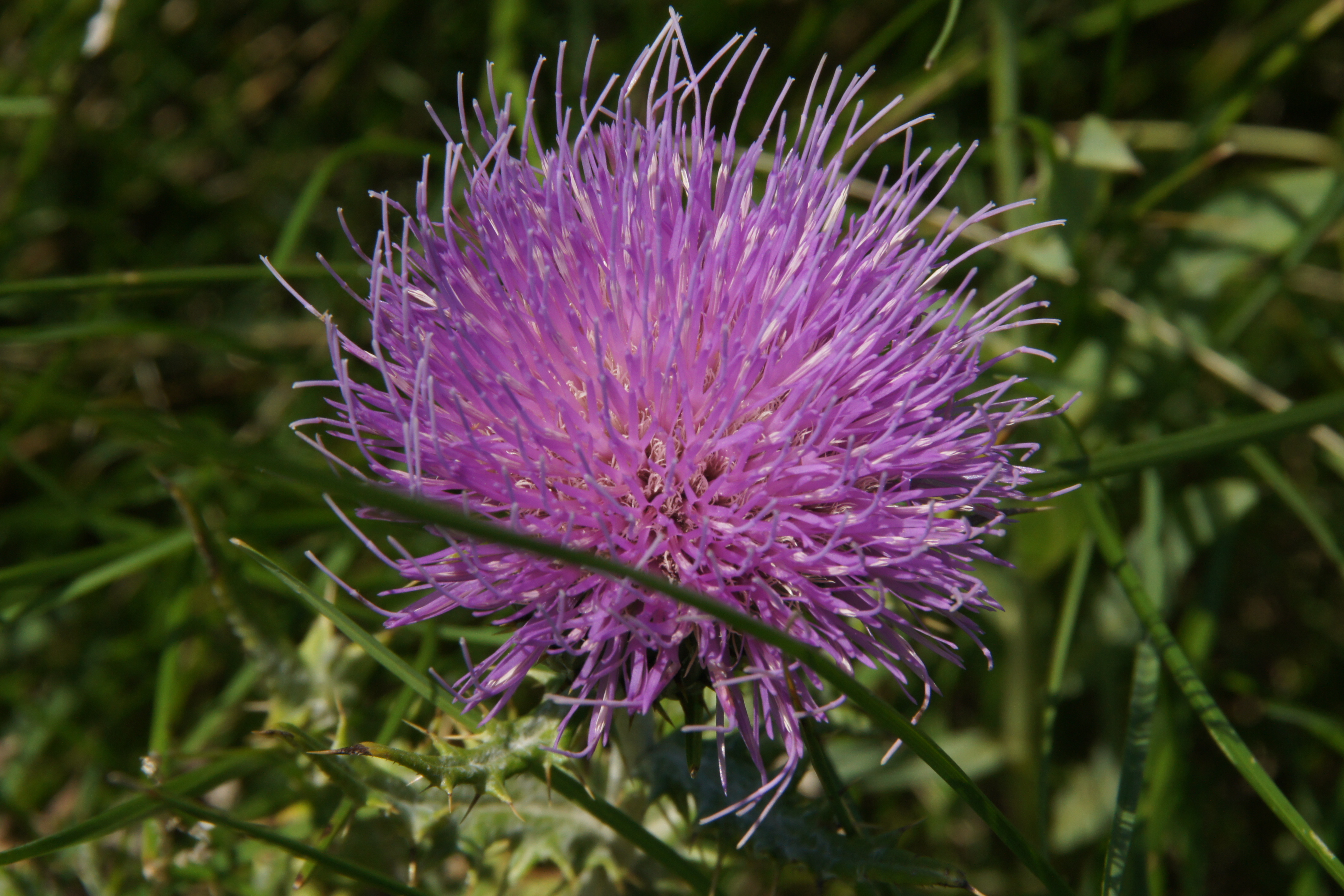
The grassland supports delicate butterflies.......colorful flowers....
We went on a tour of the Nature Conservancy’sSamuel Ordway Prairie Preserve. Aberdeen is the closest town, if you don’t count the really tiny farm communities in between. When the prairie was my destination, not something to be barreled through on my way somewhere else, I began to really look and found that the amazing grassland is teaming with wildlife, from tiny frogs and butterflies to birds and enormous buffalo, if you take the time to look at it. Actually, it’s hard to miss the buffalo.
... and enormous buffalo.
To people who are used to city or suburban life simply to be in such a vast uninhabited grassland is amazing. In her memoir, Dakota: A Spiritual Geography, Kathleen Norris talks about a friend who asked her what there is to see there. She responds, “Nothing.” And that’s precisely the point. So much open space—no telephone poles, buildings or trees and no people—is something rarely seen. It also struck how different one’s perspective on life would be, politically and otherwise, if you lived in such an area rather than a city.
On this 7,800-acre preserve, the Nature Conservancy staff manages a bison herd and conducts research on the plants and animals of this ecosystem, especially in relation to invasive exotic species. However, I was most fascinated with the land itself and the size of the sky. It would take a much tougher person than I am to live in this expanse, especially in winter.
Have you seen the guy in the cell phone ad that launches into a flash mob dance routine in New York’s Grand Central Station but discovers he’s the only one dancing? Improv Everywhere is one group that organizes choreographed events where, hopefully, everyone joins the action at the same time– for their own joy and the obvious entertainment of spectators–all for free. Check out the video of the mass-scale fun in the Hudson River Park.
Laura Ingalls Wilder would be astounded at the interest people still have in her
Laura Ingalls Wilder's beloved stories live on through pageants, tours, biographies and through her arch enemy, Nellie Oleson.
books and her life and the many forms that interest has taken. Eighty years after the publication of the first book in her Little House on the Prairie series, The Little House in the Big Woods, Laura is big business in the towns where she lived. Wendy McClure describes these places in her great book The Wilder Life, My Adventures in the Lost World of Little House on the Prairie.
It’s good the Ingalls family kept moving, because it has given each tiny town where they lived, no matter how briefly they lit there, a chance to lure visitors to the family’s various homes, cabins and indentations in the sod. For example, tiny Pepin, Wisconsin, generally the site of the Little House in the Big Woods, holds Laura Ingalls Wilder Days annually in September. In De Smet, South Dakota (By the Shores of Silver Lake), they have a Laura Ingalls Wilder Museum, all sorts of Laura-themed shops and restaurants and a pageant that is celebrating its the 40th anniversary this summer. Walnut Grove, Minnesota, (On the Banks of Plum Creek) also has a pageant and a Laura Ingalls Wilder museum. Four authors appeared at the museum last weekend to promote their books about Laura.
Of course the Little House TV series made hay from the novels and it still lives on in Hallmark Channel reruns decades after it was in production. The show was super-popular in France. I once met a woman from France…. who said all that she knew about Minnesota she learned from the Little House on the Prairie TV series. Now, so far from the prairie, Carnival Cruise lines is getting in on the Laura action, with “THE LITTLE HOUSE ON THE PRAIRIE REUNION CRUISE, a 7 Day Fan-Filled Cruise to the Mexican Riviera Mexican Riviera with the ORIGINAL Cast Aboard the Carnival Splendor, November 13 – 20 2011.”
But back on the prairie….this Saturday and Sunday, Allison Arngrim, who played Laura’s arch enemy Nellie Oleson on the TV series, will appear at the museum in Walnut Grove. An actress and stand up comedian, Arngrim pokes fun at her days as that ringlet wearing little priss, Nellie, in her book, “Confessions of a Prairie Bitch.” (I love the French title: La Petite Garce Dans La Prairie.) Check out a clip of her comedy show of the same name in which she asks, “Do you know what it means to be Nellie Olesen? It means someone has celled me a bitch every day since I was eleven.”
I certainly felt like a stranger when I visited this Berber woman and her daughter in Morocco last spring. They're part of a nomad family that travels with their animals as the seasons change. While they're in this part of the Atlas Mountains, they live in a cave. We couldn't be more different, but I didn't feel like such a stranger when she offered a cup of mint tea.
I just finished reading Ann Patchett’s newest book, State of Wonder, a fictional work in which the protagonist, Marina Singh, is a research scientist who works for a pharmaceutical company in Eden Prairie, Minnesota. The company dispatches her to the darkest reaches of Brazil to track down her former mentor, Dr. Annick Swenson. (You can read my review of the book on the online literary mag, Minnesota Reads—“they like big books and they cannot lie.”) Marina, a home-grown Minnesotan, is an outsider in the lush and chaotic jungle world of Brazil, although this weekend Minnesota will be steaming and tropical, too.
The impact of outsiders on an exotic and undeveloped environment is a common theme in literature and in the movies—think Conrad’s Heart of Darkness, H.G. Wells’ The Island of Dr. Moreau, Avatar, Indiana Jones… the list goes on. Usually, the meeting of cultures results in conflict. Freakish animal/human combinations appear (Dr. Moreau), exploitative colonists chop down the Tree of Life (Avatar). These fictional stories have me thinking about real-world travel and being a “foreigner.” Aside from some truly frightful bathrooms–I once used a bathroom in a Haitian jail–travel is usually far less scary and often far more fascinating than fiction.
Of course, you don’t need to sail to Borneo to feel like a stranger in a strange land. For example, when I go to California, people seem to have no idea where Minnesota is or what Minnesotans are like except what they may have seen on Little House On the Prairie. (Update: we no longer wear bonnets. Nor do we “tip” cows.) I’ve had people in California say, “Oh, you’re from Minnesota, do you live near Detroit?” One Californian asked me if Minneapolis is closer to Chicago or Boston. Hmm, let me think about that.
I knew I was different when a wonderful tour guide in Charleston, South Carolina, told me, “We just love the way ya’ll talk.” That surprised me because I thought he was the one who spoke with a funny accent. But if you really want to feel like a stranger, try asking someone in the Southwestern U.S. for a pop. You might as well be speaking Greek. For you non-Midwesterners, I’m talking about a carbonated beverage. See the New York Times’ pop, soda, coke map.
Paul Theroux says in his latest book, a great travel writing compilation, The Tao of Travel
It is hard to be a stranger. A traveler has no power, no influence, no known identity. That’s why a traveler needs optimism and heart, because without confidence travel is misery. Generally, the traveler is anonymous, ignorant, easy to deceive, at the mercy of the people he or she travels among. The travelers might be known as “the American” or “the Foreigner,” and there is no power in that.
But feeling strange is exhilarating, half the fun of travel. And, despite the dangers some fictional travelers encounter, it’s usually an overwhelmingly positive experience for those of us in the real world. Theroux offers these tips as the “Essential Tao of Travel:”
1. Leave home (no problem)
2. Go alone
3. Travel light (often a big problem)
4. Bring a map
5. Go by land
6. Walk across a national frontier
7. Keep a journal
8. Read a novel that has no relation to the place you’re in
I just finished reading A Skeptic’s Guide to Writers’ Houses, a tour of the homes of writers ranging from Hemingway to Poe to Langston Hughes by writer and English professor Anne Trubek. In this funny and very insightful book, Trubek examines the lure of writers’ homes for readers and for herself. And a big draw it is; she says there are about seventy-three writers houses open to the public in the U.S. and hundred of thousands of people visit them annually, 60,000 a year to Mark Twain’s house in Hartford alone. But, such pilgrimages aren’t always very satisfying. She says
Writers’ house museums expose the heartbreaking gap between writers and readers. Part of the pull of a writer’s house is the desire to get as close as possible to the precise, generative, “Aha!” But we can never get there….Going to a writer’s house is a fool’s errand. We will never find our favorite characters or admired techniques within these houses; we can’t join Huck on the raft or experience Faulkner’s stream of consciousness. We can only walk through empty rooms full of pitchers and paintings and stoves.”
But A Skeptic’s Guide is entertaining precisely because, for Trubek the houses always come up short, which she describes in a pleasantly un-snarky way. For example, visitors and tour guides often seem to confuse the idea that a house was where the writer lived and not where the fictional characters like Huck Finn or Jo in Little Women lived. The furniture, papers and other items in the houses are often not those that belonged to the writer, but are things the curator added willy-nilly. Edith Wharton’s home, The Mount, is decorated as a modern-day show house, computer and all. Most houses seem to have the same array of merchandise in the gift shop.
I agree with her. I’ve never really seen the lure of an author’s homes as some way to commune with the departed genius or magically attain the writer’s magic for my own use. However, I’m fascinated with the sense of place that literature creates. When I read about Huck Finn, it makes me want to not visit Twain’s Hannibal home but rather to hop in a boat and travel down the Mississippi. For a Yankee like me, it’s exciting to visit the Carolina lowcountry I’ve read about in books such as Pat Conroy’s Prince of Tides or The Water is Wide. I get a better understanding of the real people who live there as well as their history and the geography that has shaped it.
Ultimately, the essence of the writer isn’t in the house, it’s in the words. Trubeck concludes, “[Langston] Hughes knew that …the world of the imagination would offer him more than the city, more than a house.”
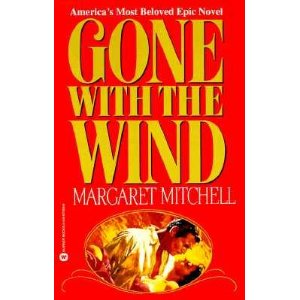
Despite its political incorrectness and my yankee heritage, Margaret Mitchell’s Gone With the Wind is one of my favorite books. It was published 75 years ago–it seems like only yesterday. Check out National Public Radio’s terrific articles and reports about the book’s 75th anniversary. This occasion makes the book a great choice for book clubs–plenty new to talk about. And, it’s the 150th anniversary of the Civil War, so it’s timely. Be sure to read Pat Conroy’s chapter about Gone With the Wind in his book My Reading Life.
I may be a fan of the book, but I’m nowhere near as devoted as a group of hard-core GWTW fans called the Windies who the New York Times describes as “so ardent that recreating the burning of Atlanta in an airport hotel banquet room is not out of the question.” I can’t join them. It’s just too hot for a hoop skirt.
Travel to the places you read about. Read about the places you travel.






 Off The Beaten Page Travel