We Always Knew It: Nellie Oleson is a Prairie B****

Laura Ingalls Wilder would be astounded at the interest people still have in her

Laura Ingalls Wilder's beloved stories live on through pageants, tours, biographies and through her arch enemy, Nellie Oleson.

books and her life and the many forms that interest has taken.  Eighty years after the publication of the first book in her Little House on the Prairie series, The Little House in the Big Woods, Laura is big business in the towns where she lived.  Wendy McClure describes these places in her great book The Wilder Life, My Adventures in the Lost World of Little House on the Prairie.

It’s good the Ingalls family kept moving, because it has given each tiny town where they lived, no matter how briefly they lit there, a chance to lure visitors to the family’s various homes, cabins and indentations in the sod. For example, tiny Pepin, Wisconsin, generally the site of the Little House in the Big Woods, holds Laura Ingalls Wilder Days annually in September. In De Smet, South Dakota (By the Shores of Silver Lake), they have a Laura Ingalls Wilder Museum, all sorts of Laura-themed shops and restaurants  and a pageant that is celebrating its the 40th anniversary this summer. Walnut Grove, Minnesota, (On the Banks of Plum Creek) also has a pageant and a Laura Ingalls Wilder museum.  Four authors appeared at the museum last weekend to promote their books about Laura.

Of course the Little House TV series made hay from the novels and it still lives on in Hallmark Channel reruns decades after it was in production. The show was super-popular in France.  I once met a woman from France…. who said all that she knew about Minnesota she learned from the Little House on the Prairie TV series. Now, so far from the prairie, Carnival Cruise lines is getting in on the Laura action, with “THE LITTLE HOUSE ON THE PRAIRIE REUNION CRUISE, a 7 Day Fan-Filled Cruise to the Mexican Riviera Mexican Riviera with the ORIGINAL Cast Aboard the Carnival Splendor, November 13 – 20 2011.”

But back on the prairie….this Saturday and Sunday, Allison Arngrim, who played Laura’s arch enemy Nellie Oleson on the TV series, will appear at the museum in Walnut Grove. An actress and stand up comedian, Arngrim pokes fun at her days as that ringlet wearing little priss, Nellie, in her book, “Confessions of a Prairie Bitch.” (I love the French title: La Petite Garce Dans La Prairie.) Check out a clip of her comedy show of the same name in which she asks, “Do you know what it means to be Nellie Olesen?  It means someone has celled me a bitch every day since I was eleven.”

Seems like it was worth it.

Pop, Soda, Coke, Mint Tea? On Being a Stranger in a Strange Land

I certainly felt like a stranger when I visited this Berber woman and her daughter in Morocco last spring. They're part of a nomad family that travels with their animals as the seasons change. While they're in this part of the Atlas Mountains, they live in a cave. We couldn't be more different, but I didn't feel like such a stranger when she offered a cup of mint tea.

I just finished reading Ann Patchett’s newest book, State of Wonder, a fictional work in which the protagonist, Marina Singh, is a research scientist who works for a pharmaceutical company in Eden Prairie, Minnesota.  The company dispatches her to the darkest reaches of Brazil to track down her former mentor, Dr. Annick Swenson. (You can read my review of the book on the online literary mag, Minnesota Reads—“they like big books and they cannot lie.”) Marina, a home-grown Minnesotan, is an outsider in the lush and chaotic jungle world of Brazil, although this weekend Minnesota will be steaming and tropical, too.

The impact of outsiders on an exotic and undeveloped environment is a common theme in literature and in the movies—think Conrad’s Heart of Darkness, H.G. Wells’ The Island of Dr. Moreau, Avatar, Indiana Jones… the list goes on.  Usually, the meeting of cultures results in conflict. Freakish animal/human combinations appear (Dr. Moreau), exploitative colonists chop down the Tree of Life (Avatar).  These fictional stories have me thinking about real-world travel and being a “foreigner.” Aside from some truly frightful bathrooms–I once used a bathroom in a Haitian jail–travel is usually far less scary and often far more fascinating than fiction.

Of course, you don’t need to sail to Borneo to feel like a stranger in a strange land.  For example, when I go to California, people seem to have no idea where Minnesota is or what Minnesotans are like except what they may have seen on Little House On the Prairie. (Update:  we no longer wear bonnets.  Nor do we “tip” cows.) I’ve had people in California say, “Oh, you’re from Minnesota, do you live near Detroit?”  One Californian asked me if Minneapolis is closer to Chicago or Boston.  Hmm, let me think about that.

I knew I was different when a wonderful tour guide in Charleston, South Carolina, told me, “We just love the way ya’ll talk.”  That surprised me because I thought he was the one who spoke with a funny accent.  But if you really want to feel like a stranger, try asking someone in the Southwestern U.S. for a pop.  You might as well be speaking Greek.  For you non-Midwesterners, I’m talking about a carbonated beverage.  See the New York Timespop, soda, coke map.

Paul Theroux says in his latest book, a great travel writing compilation, The Tao of Travel

It is hard to be a stranger.  A traveler has no power, no influence, no known identity. That’s why a traveler needs optimism and heart, because without confidence travel is misery.  Generally, the traveler is anonymous, ignorant, easy to deceive, at the mercy of the people he or she travels among. The travelers might be known as “the American” or “the Foreigner,” and there is no power in that.

But feeling strange is exhilarating, half the fun of travel.  And, despite the dangers some fictional travelers encounter, it’s usually an overwhelmingly positive experience for those of us in the real world. Theroux offers these tips as the “Essential Tao of Travel:”

1. Leave home (no problem)

2.  Go alone

3. Travel light (often a big problem)

4. Bring a map

5. Go by land

6. Walk across a national frontier

7. Keep a journal

8. Read a novel that has no relation to the place you’re in

9. If you must bring a cell phone, avoid using it

10. Make a friend (see the photo above)

A Skeptic’s Guide to Writers' Houses

I just finished reading A Skeptic’s Guide to Writers’ Houses, a tour of the homes of writers ranging from Hemingway to Poe to Langston Hughes by writer and English professor Anne TrubekIn this funny and very insightful book, Trubek examines the lure of writers’ homes for readers and for herself.  And a big draw it is; she says there are about seventy-three writers houses open to the public in the U.S. and hundred of thousands of people visit them annually, 60,000 a year to Mark Twain’s house in Hartford alone. But, such pilgrimages aren’t always very satisfying. She says

Writers’ house museums expose the heartbreaking gap between writers and readers. Part of the pull of a writer’s house is the desire to get as close as possible to the precise, generative, “Aha!” But we can never get there….Going to a writer’s house is a fool’s errand. We will never find our favorite characters or admired techniques within these houses; we can’t join Huck on the raft or experience Faulkner’s stream of consciousness. We can only walk through empty rooms full of pitchers and paintings and stoves.”

But A Skeptic’s Guide is entertaining precisely because, for Trubek the houses always come up short, which she describes in a pleasantly un-snarky way.  For example, visitors and tour guides often seem to confuse the idea that a house was where the writer lived and not where the fictional characters like Huck Finn or Jo in Little Women lived.  The furniture, papers and other items in the houses are often not those that belonged to the writer, but are things the curator added willy-nilly.  Edith Wharton’s home, The Mount, is decorated as a modern-day show house, computer and all.   Most houses seem to have the same array of merchandise in the gift shop.

I agree with her.  I’ve never really seen the lure of an author’s homes as some way to commune with the departed genius or magically attain the writer’s magic for my own use.  However, I’m fascinated with the sense of place that literature creates.  When I read about Huck Finn, it makes me want to not visit Twain’s Hannibal home but rather to hop in a boat and travel down the Mississippi. For a Yankee like me, it’s exciting to visit the Carolina lowcountry I’ve read about in books such as Pat Conroy’s Prince of Tides or The Water is Wide.  I get a better understanding of the real people who live there as well as their history and the geography that has shaped it.

Ultimately, the essence of the writer isn’t in the house, it’s in the words. Trubeck concludes, “[Langston] Hughes knew that …the world of the imagination would offer him more than the city, more than a house.”

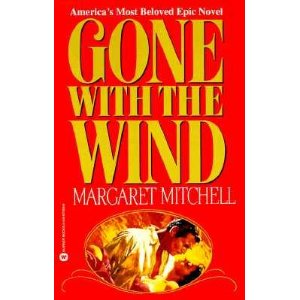
Does this hoop skirt make my butt look big? "Gone With the Wind" at 75

Despite its political incorrectness and my yankee heritage, Margaret Mitchell’s Gone With the Wind is one of my favorite books. It was published 75 years ago–it seems like only yesterday.  Check out National Public Radio’s terrific articles and reports about the book’s 75th anniversary. This occasion makes the book a great choice for book clubs–plenty new to talk about. And, it’s the 150th anniversary of the Civil War, so it’s timely. Be sure to read Pat Conroy’s chapter about Gone With the Wind in his book My Reading Life.

I may be a fan of the book, but I’m nowhere near as devoted as a group of hard-core GWTW fans called the Windies who the New York Times describes as “so ardent that recreating the burning of Atlanta in an airport hotel banquet room is not out of the question.”  I can’t join them.  It’s just too hot for a hoop skirt.

No e-Books Here, Only Rare Books

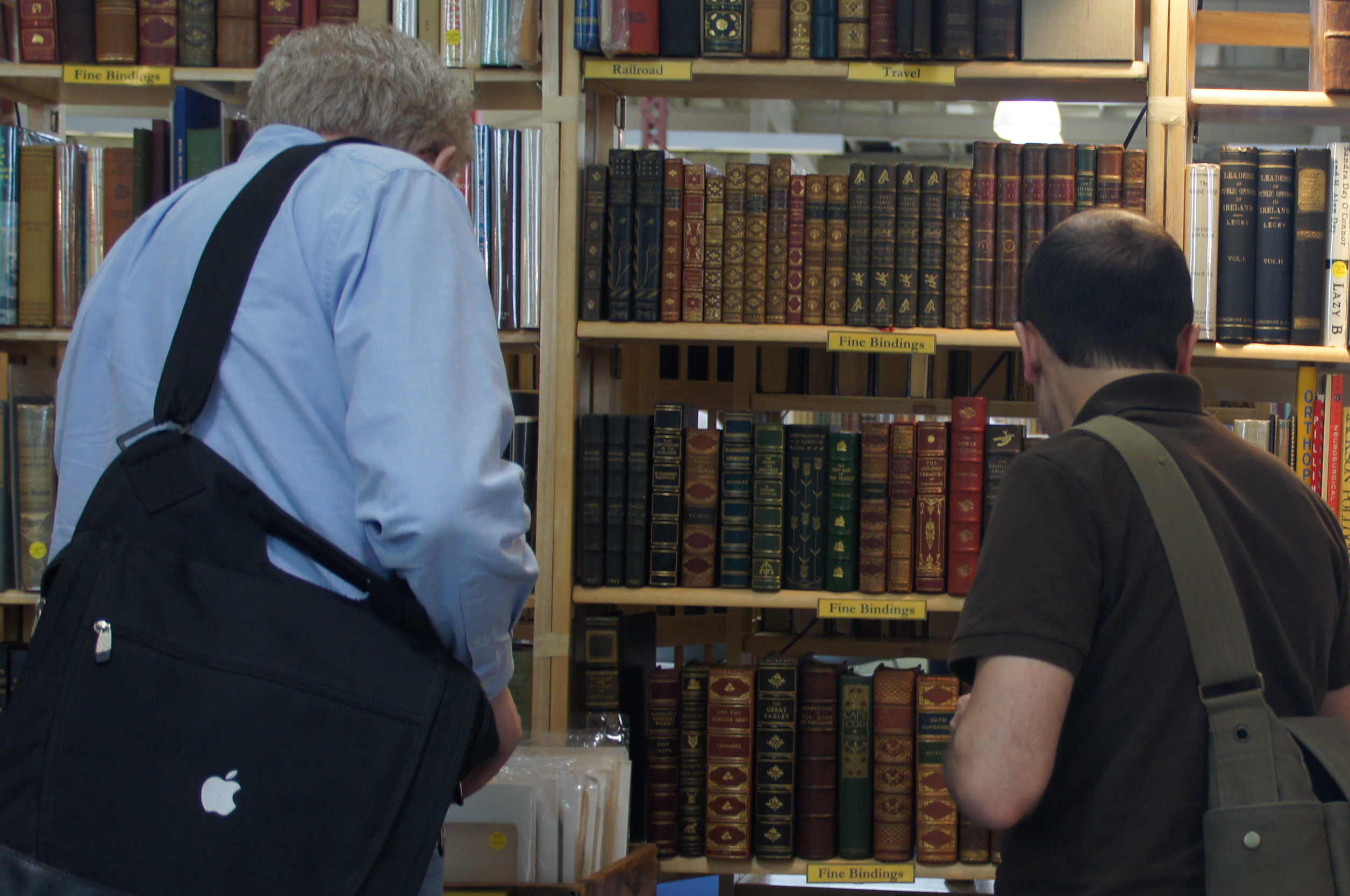
Rare books are like works of art. Browsers at the Twin Cities Antiquarian Book Fair.

No matter how much you love your e-reader, the books it contains will never look beautiful on your shelves and those electronic books will never appreciate in value.  You’ll never feel the weight or the texture of digital books, the care that went into binding them or wonder who held those books before you.

Those facts were particularly striking last weekend as I strolled the stalls of the 21st annual Twin Cities Antiquarian and Rare Book Fair at the Minnesota State Fairgrounds.  The shelves were full of lovely leather-bound, gold embossed rare books as well as first editions from the likes of Ernest Hemingway, William Faulkner, Ray Bradbury and scads of others.  Picking them up was like holding a piece of literary history. I kept waiting for someone to slap my hands and say, “You touch it, you buy it,” but no one did.  One of the marquee items for sale was a first edition of F. Scott Fitzgerald’s Tender Is the Night, which probably sold for a buck or two in the 1920s, but was listed on Saturday for $35,000.

I have rare-book taste but a garage-sale-paperback budget, so Tender is the Night wasn’t among my purchases. Nonetheless, there were more affordable options including books for as little as $5.  But the real fun for me was to be among people who are even more book-obsessed than I am.  These are not the same people you would find at, say, the Pet-a-Palooza that was going on in the building next door. (That looked like a lot of fun, too.) It was a crowd that might be described as “professorial.” I ran into a friend who said he was sure he was the only guy there without a beard.

Though they deal in valuable volumes, the booksellers at these events are a friendly bunch and happy to discuss the business (which is doing pretty well) and share their tips on collecting books and spotting first editions.  Original dust jackets are a must, signed by the author.  I lingered and lurked around the desk where dealers where appraising books that people brought in; it was like watching “Antiques Roadshow,” only for books. Who knew a book fair could have such drama? One woman hauled in a pile of books that looked like they had been in her attic since the 30’s and she was more than a little distressed to find they were worth about $5 max (the agony of defeat!).  Another gentleman who brought his books in a briefcase as if he were delivering ransom money walked away a happy man with the knowledge that several of his tomes were worth a few hundred dollars (the thrill of victory!)—with dust jackets and signatures, of course.

As e-readers continue to grow in popularity, rare books will only become rarer, but I’m hoping they won’t become nearly worthless like old PCs or film cameras, but rather more like valuable Chippendale furniture. For more on the world of antique and collectible books, check out the International League of Antiquarian Booksellers. And, if you’re looking for a book fair to attend, the The Midwest Antiquarian Booksellers holds their big Chicago show in August.

Should Book Stores Charge for Author Events?

Yesterday’s New York Times business section, had an article about independent book stores charging people to attend author events, Come Meet the Author, but Open Your Wallet. I hadn’t thought of this as a trend even though I’ve coughed up more than a few dollars to see authors in person.  It’s usually an experience that goes well beyond a sales spiel about a book.

For example, I went to an event last week with David McCullough who gave an hour-plus

David McCullough, out to promote his new book, The Greater Journey. Is it worth it to pay to attend author events?

talk about his book The Greater Journey and his career in general.  The Bookcase, an independent bookseller in Wayzata, Minnesota, held the event at a local church to accommodate the large crowd. The tab: $20 per ticket, with $10 of that going toward the purchase of the book.  I left the event having had the pleasure of hearing McCullough speak and I walked out with a new hardcover copy of the book.  I was a happy camper. From the looks of it, the hundreds of people in attendance (who also left with copies of the book, many signed by the author) were equally happy, and it seems as a result The Bookcase and the author must have been pleased as well.

According to the New York Times article, “Bookstore owners say they are charging for author events because too many people regularly come to see authors having already bought a book online or planning to do so later. Consumers now see the bookstore merely as another library — a place to browse, do informal research and pick up staff recommendations.”

“They type titles into their iPhones and go home,” Nancy Salmon, the floor manager at Kepler’s, an indie bookstore in Menlo Park, Calif., told the paper.  “We know what they’re doing, and it has tested my patience.” (I have to confess I’ve been a lurker at these events and left the store empty handed.)

The downside of charging is that it may discourage people from attending author events and thus diminish the sense of a readers’ community that bookstores create.  That’s one thing that sets indies apart from the online booksellers, live interconnectedness, serving as a sort of cultural center.  The article quotes novelist Ann Patchett, who is currently touring to promote her new book, State of Wonder and who says she is concerned that people who do not have enough money to buy a hardcover book — especially students or the elderly — might be left out. “I wouldn’t want the people who have no idea who I am and have nothing else to do on a Wednesday night shut out,” she said. “Those are your readers.”

Yet for every Ann Patchett or David McCullough, authors who can attract a crowd to events because they’re already well known, there are little-known authors who booksellers could never charge you to see.  It’s every new author’s nightmare to stand alone in the back of the store with no one except the store manager to hear her presentation.

I say it’s okay for bookstores to charge for the big names that will draw people in and spur them to buy books, especially if a portion of the fee can go toward book purchases. It might even make more author events seem like a “hot ticket.”

Who Was Abe Lincoln? Lit and History Road Trips for Families

Famed historian David McCullough gave a presentation about his new book, The Greater

Ideas to plan a reading road trip

Journey: Americans in Paris, on Tuesday night in Wayzata, Minnesota, near Minneapolis.  It’s the story of American artists, writers, physicians, politicians and others who traveled to Paris between 1830 and 1900 to further their education and to excel at their work. I highly recommend it to anyone traveling to Paris.

But one of the most interesting parts of the evening was when someone asked McCullough his opinion of Americans’ knowledge of history and the way history is taught in our schools.  That’s a particularly hot topic this week because of Sarah Palin’s rewriting of history and also because the National Assessment of Educational Progress found that American students are less proficient in their nation’s history than in any other subject.  The New York Times said that, according to results of a nationwide test released on Tuesday, most fourth graders were unable to say why Abraham Lincoln was an important figure. McCullough’s suggestion:  don’t fault the teachers.  It’s our own responsibility.  Parents,  grandparents, and others must do a better job of showing an interest in history and discussing it with children.

A great way for children to learn a little U.S. colonial history

Family road trips are one of the best ways to do that.  It’s what educators call “placed-based learning” and, it ties in nicely with the idea of inspiring children to read by making stories more vivid and bringing reading to life.  I’m not talking about hard-core history books here, but rather books that are fun to read. For example, read Esther Forbes’ Johnny Tremain and visit Boston.  Pair Mark Twain’s Huckleberry Finn or Tom Sawyer with a trip to see the Mississippi River or Twain’s home in Hannibal Missouri.  Read the Little House on the Prairie series and travel to the sites where Laura Ingalls Wilder really lived.  How about Brighty of the Grand Canyon?  Remember that one? The list goes on. Not only do lit trips fuel a young reader’s imagination, they also give a sense of history and an understanding of what life was like earlier in our history.

One of the best books to inspire a reading road trip is Storybook Travels: From Eloise’s New York to Harry Potter’s London, Visits to 30 of the Best-Loved Landmarks in Children’s Literature by Susan La Tempa and Colleen Dunn Bates.  Here are a few other Web sites that offer great reading road trip ideas:

KidLit History  whose motto is “Everything I need to know about history I learned through children’s literature.”

Mommy Poppins.com

Travel Guide Through Children’s Literature

I can’t resist this one about Dr. Seuss-like places.

Parenthood.com 

Parentschoice.org

Greater Dayton Public Television 

Unputdownables

Here’s a library site, and finally,

National Geographic Traveler’s Ultimate Travel Library

So, with a tiny bit of research, you could pair a book about Abe Lincoln and a trip that would show both kids and parents why Abraham Lincoln was important… or why Paul Revere made that famous ride.

An F. Scott Fitzgerald Walk in St. Paul

I took a walk last week through the Summit Hill neighborhood of St. Paul, Minnesota,

F. Scott Fitzgerald's debut novel This Side of Paradise

where F. Scott Fitzgerald was born, grew up, wrote his first stories and made the revisions on his debut novel, This Side of Paradise. (If its original not-so-catchy title The Romantic Egoist is any indicator, I can see why they suggested revisions)

Even if you’re not a big Fitzgerald fan, even if you don’t know Amory Blaine from Jay Gatsby, this is a great neighborhood for a stroll, especially in summer. With its gorgeous Victorian homes, overarching elm trees and fun shops nearby it’s—if not this side of paradise—really, really nice.

The St. Paul Public Library (which has a special Fitzgerald reading alcove) offers a brochure called “F. Scott Fitzgerald in St. Paul—Homes and Haunts” that you can download. Start the tour at 481 Laurel Ave., where Fitzgerald was born. Park there and start the walk. The house where his parents later lived (593/599 Summit) and where he finished This Side of Paradisehe described as “A house below the average on a street above the average.”

Fitzgerald's neighborhood is still above average and has many beautifully restored Victorian homes.

Published in 1920, this work launched his career as spokesman for the Jazz Age. He chronicles the changing mores of the generation of wild children of Victorian parents, who Gertrude Stein later dubbed the “Lost Generation.”  Fitzgerald presciently wrote in the most famous passage of the novel, “Here was a new generation, . . . dedicated more than the last to the fear of poverty and the worship of success, grown up to find all Gods dead, all wars fought, all faiths in man shaken.”

F. Scott Fitzgerald's St. Paul birthplace

Be sure to make a stop at W.A. Frost (374 Selby), which has the world’s best outdoor dining, part of your tour.  Frost’s was a drug store and soda fountain during Fitzgerald’s day and retains its historic charm.  Finally, end your tour across the street from W.A. Frost at Common Good Books (downstairs at 165 Western Avenue North), whose proprietor is another St. Paul author and host of “A Prairie Home Companion,” Garrison Keillor. It’s a gem of a bookstore.  To read more of Fitzgerald’s St. Paul works, look for The St. Paul Stories of F. Scott Fitzgerald, edited by another St. Paul author, Patricia Hampl.  Read “The Ice Palace,” “Winter Dreams,” and “A Night at the Fair.”

The real Wilder Life versus my imaginary Wilder Life. I’ll take the latter.

I’ve been reading Wendy McClure’s The Wilder Life in which she recounts her love of Laura Ingalls Wilder‘s  Little House on the Prairie books and her effort to re-create “Laura World” for herself. So, it was a fun coincidence to read a post on the Algonquin Books blog about An American Childhood by Annie Dillard.  Dillard says of her childhood:

What I sought in books was imagination. It was depth, depth of thought and feeling; some sort of extreme of subject matter; some nearness to death; some call to courage. I myself was getting wild; I wanted wildness, originality, genius, rapture, hope. I wanted strength, not tea parties. What I sought in books was a world whose surfaces, whose people and events and days lived, actually matched the exaltation of the interior life. There you could live.

That describes the qualities that have sent generations of young readers flocking to the Little Housebooks, and surely what sent McClure on her journey into “Laura World.”  What fan of “Half-Pint Ingalls” (who thanks to McClure now has her own Twitter account

Laura "Half Pint" Ingalls has her own Twitter account @halfpintingalls.

@halfpintingalls) hasn’t secretly wanted to venture just a little into Laura World? It was a relief to find someone so quirkily devoted to books and McClure’s descriptions of her attempts at some of the Little House activities—churning butter, for example, or making Vanity Cakes—are hilarious. I particularly enjoyed the chapter where she and her ever-patient significant other, Chris, spend a bit of time on a farm learning do-it-yourself skills that might have been of use in Laura World but it turns out they’ve joined a gathering of fundamentalists preparing for “end times.”  

I’m a huge advocate of  reading books to get a better understanding of places one is traveling.  And, a “field trip” to the place where a book took place extends the experience of reading the book. For example, what does fiction such as the Little House books tell us about life in the late 18th century and how does that experience affect us now?  How well would I measure up to the challenges of pioneer life?  How does the Long Winter of Wilder’s experience compare to the long winter I just experienced? I can tell you one thing:  it makes me happy to have central heat and store-bought sticks of butter in the frig.  I’m happy I don’t have to butcher a hog and make head cheese, though I’ve always had a kind of gross fascination with the way the Little House younguns blew up pig bladders and used them as balls.

But McClure also delves into the research about Laura Ingalls Wilder and the dynamics of Laura’s relationship with her daughter, Rose.  She discovers just how far the Little House books deviate from the life of the real Wilders and, (Holy Hoedown!) the suspicion that Rose had more of a hand in writing the books than Laura.

It makes me wonder if there’s a danger in learning too much. It just might diminish the magic of reading in the first place.  The real Laura World doesn’t hold a hand-dipped tallow candle to the world Laura created in our imaginations. I’m going to meet up later this summer with a group of Wilder fans from the Book Vault (see my previous post) in Oskaloosa, Iowa as they hit the Little House hot spots near Minneapolis where I live.  I’ll dip my toes in the water On the Banks of Plum Creek, but my view of Laura World will remain the one in  my own imagination.

Bikes and Books Tour of Minneapolis

The Twin Cities are regularly rated among the most literary cities in the country
(check out Flavorwire‘s pairing of top cities and books set in them) and Minneapolis has been voted the best biking city in America for the last two years.  So it makes sense to put the two together for a two-wheel tour of some of Minneapolis’ outstanding independent bookstores as well as its famous Chain of Lakes.  FYI, for anyone not familiar with this area of Minneapolis, we’re talking flat, paved bikes-only paths, great for kids and anyone who may not be Tour-de-France-fit.

Start out in the city’s Uptown neighborhood, home of some of Minneapolis’ most fun bars and restaurants, as proven by the continual discussion of noise regulations for the area at city council meetings.  It’s also the home of Magers and Quinn on Hennepin Avenue, the city’s largest independent bookseller which bills itself as “A bounty of the world’s best books assembled by biblioholic booksellers.”  This is a place that will make even the most dedicated e-book reader stow the tech and stock up on print.  It has that cozy independent bookstore feel and stacks you could wander for hours. They have everything, new, used (deals!), beautiful antique volumes and first editions…so bring your backpack.  And, if they don’t have a book you’re looking for, they’ll track it down and order it for you.  It’s also a good idea to get on their mailing list for author appearances and reading ideas.

If you haven’t come equipped, trot around the corner to Calhoun Bike Rentals on Lake Street and rent a bike for the rest of your journey.   They also offer bike tours of some of the most interesting areas of Minneapolis.

The Tin Fish restaurant in the Lake Calhoun Boat Pavillion makes a great place to stoke up for lunch. Then start pedaling.  The Chain of Lakes is part of the Grand Rounds National Scenic Byway.  Head south along the east side of Lake Calhoun and on down to Lake Harriet.

A short side trip from Lake Harriett is Wild Rumpus Books a fantastic children’s bookstore that features, in addition to books, live animals and a tiny front door for children to enter through.

Head back to Lake Harriet and north again to Lake Calhoun, Lake of the Isles and on to Birchbark Books and Native Arts in the lovely, leafy Kenwood neighborhood.  It’s one of my favorite bookstores (see my previous post) with a special emphasis on Native American literature.  The staff and owner, novelist Louise Erdrich, carefully choose the books here and handwritten notes offer insight into books for browsers.  Books aside, any store with a confessional and dogs on the premises is good for the soul. You’ll need a little nosh to sustain you as you retrace your path back to Uptown.  Stop next door at the Kenwood Café.

Many bibliophiles make a point of hitting independent bookstores such as these whenever they travel.  To that end, IndieBound has an Indie Store finder that helps readers find indie booksellers just about anywhere.  For more on bookstore tourism, take a look at GalleyCat and Bookstore Tourism.

Travel to the places you read about. Read about the places you travel.